This change is now live on mainnet following a decisive community vote.
After three days of on-chain voting between October 28 and October 31, 2025 (UTC), Triones nodes approved the ONG Tokenomics Adjustment Proposal with 117 million votes in favor and zero votes against.
This is one of the strongest expressions of community alignment in Ontology’s history.
With the mainnet upgrade complete, this announcement marks more than a technical update.
It reflects a cultural shift toward long-term sustainability, stronger liquidity, and a builder-first mindset.
Why This Matters for the Ontology Community
Ontology’s two-token system is designed for reliability and security:
- ONT powers governance and staking
- ONG fuels transactions, network usage, and contributor rewards
By permanently reducing ONG’s supply, this upgrade strengthens the long-term foundation of the ecosystem.
This vote was not just about token mechanics.
It was about the culture we want to build:
- A culture of clarity
- A culture of sustainability
- A culture where builders can trust the system to support their work for decades
The Key Changes, Clearly Explained
ONG Max and Total Supply Reduced to 800 Million
- 200 million ONG has been permanently burned
- Maximum and total supply is now fixed at 800 million ONG
This is a hard cap. No additional ONG can ever be created beyond this limit.
A tighter supply model creates a stronger foundation for long-term value, predictability, and confidence.
Circulating Supply Is Unchanged Today, but Will Reduce Over Time
There is no immediate change to circulating supply.
However:
- 100 million ONG worth of ONT and ONG is now being permanently locked through the new liquidity mechanism
- These assets are removed from circulation forever
Over time, this is expected to reduce effective circulating supply to approximately 750 million ONG, assuming 1 ONG ≈ 1 ONT.
This aligns with Ontology’s commitment to responsible token management and long-term supply discipline.
ONG Emissions Remain Stable and Predictable
ONG has always followed a steady, transparent release schedule.
To avoid a sharp increase in emissions near the end of the original schedule, the community approved a small extension.
Key points:
- ONG continues to release at 1 ONG per second
- The release period extends from 18 years to approximately 19 years
- The emission curve remains smooth and predictable
This ensures long-term stability for stakers, developers, and ecosystem partners.
The Core of This Upgrade: Stronger, Permanent Liquidity
Liquidity is not a technical footnote.
It is foundational to a healthy ecosystem.
A strong network is one where:
- Users can move assets with confidence
- Builders trust liquidity depth for real usage
- Developers avoid sudden market shocks
- Long-term contributors are protected from instability
How the New Liquidity Mechanism Works
- ONG is used to acquire ONT
- ONG and ONT are paired into liquidity provider (LP) tokens
- LP tokens are permanently burned
- The underlying assets are locked forever
This creates permanent, non-removable liquidity that strengthens Ontology’s DeFi and infrastructure layers.
The result is a more resilient market environment that builders can rely on.
Community Questions Answered
How long will the ONT and ONG equivalent to 100 million ONG remain locked?
Permanently.
Why was the release period extended?
To maintain a stable emission rate rather than increasing emissions sharply near the end of the original schedule.
Will ONT staking rewards change?
ONG emissions decrease slightly (around 20%).
However, tighter supply and stronger liquidity may improve long-term value for stakers.
How does this benefit the ecosystem?
With:
- A hard cap of 800 million ONG
- An immediate burn of 200 million ONG
- 100 million ONG permanently locked via burned liquidity
The token economy becomes healthier, more predictable, and more sustainable.
Who participated in the vote?
All Triones nodes voted via OWallet.
What Happens Next
The mainnet upgrade is complete, and all tokenomics improvements are now active.
Ongoing monitoring will focus on:
- Staking incentives
- DEX liquidity health
- ONG emission progress
- Long-term supply management
The rollout is designed to remain smooth and stable for all participants.
Building a Culture Builders Can Trust
This upgrade is not just about numbers.
It represents Ontology’s values:
- Predictability
- Sustainability
- Transparency
- Liquidity deep enough to support real activity
- A long-term mindset that respects both users and builders
Thank you to every community member and node that participated.
This decision sets the tone for Ontology’s next chapter.
We’re building for the long term — and we’re building it together.
]]>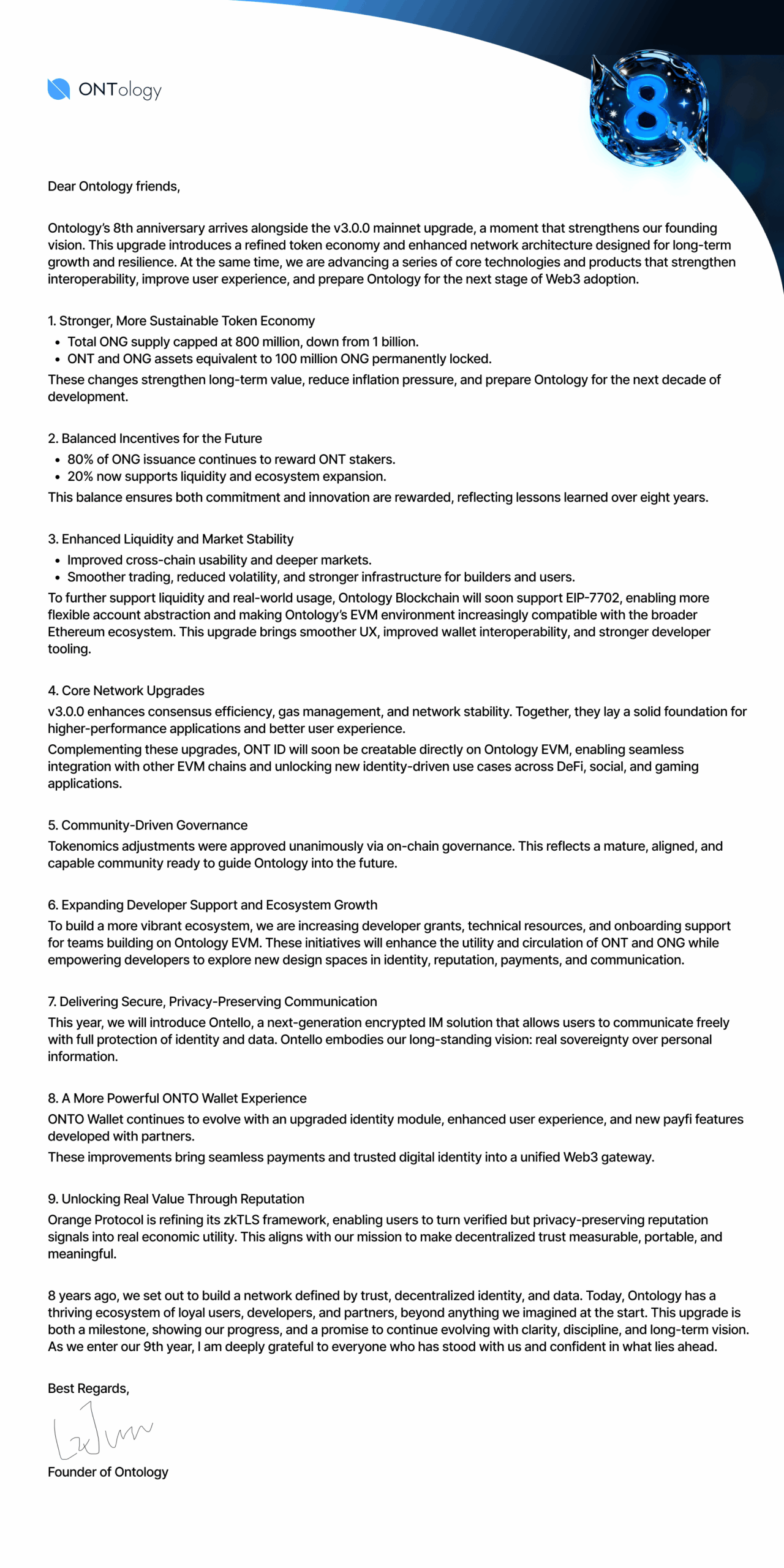
Key Highlights From Ontology’s v3.0.0 MainNet Upgrade
Strengthened Token Economy and Incentive Model
Ontology’s v3.0.0 upgrade introduces major improvements to Ontology’s dual-token model (ONT and ONG), designed to support long-term sustainability and ecosystem growth.
- The total ONG supply has been reduced from 1 billion to 800 million, with 100 million ONG permanently locked. This lowers inflation and strengthens long-term token value.
- Updated reward distribution now allocates 80% of newly issued ONG to ONT stakers and 20% to liquidity and ecosystem expansion, balancing network security with growth incentives.
These changes align Ontology’s token model with long-term utility and healthier economic design.
Network Upgrades, Identity Integration, and Governance
The v3.0.0 upgrade enhances the core performance, interoperability, and identity tooling of the Ontology Blockchain.
- Upcoming support for EIP-7702 will introduce a more flexible account system and stronger compatibility with the Ethereum ecosystem, improving cross-chain liquidity and builder experience.
- Core upgrades to consensus, stability, and gas management make the network faster and more reliable.
- ONT ID will soon be creatable directly on Ontology EVM, unlocking seamless decentralized identity use cases across DeFi, gaming, and social platforms.
- All tokenomics updates were approved through on-chain governance, reflecting a mature and aligned Ontology community.
These improvements position Ontology as a more interoperable, identity-driven, and community-governed Web3 infrastructure layer.
Product Enhancements, Developer Growth, and Real-World Utility
Ontology continues to expand its ecosystem with new tools, user experiences, and privacy-preserving features.
- Expanded grants, developer tools, and onboarding resources make it easier to build with ONT, ONG, and ONT ID.
- A new encrypted IM solution launching later this year will leverage decentralized identity and zero-knowledge technology to protect user sovereignty and secure communication.
- The ONTO Wallet has been upgraded with a refined identity module, better UX, and new payfi functionality developed with partners, improving Web3 payments and digital identity management.
- Orange Protocol is advancing its zkTLS framework to turn verified, privacy-preserving reputation signals into real economic utility — strengthening Ontology’s mission to make decentralized trust measurable and portable.
Recommended Reading
ONG Tokenomics Adjustment Proposal Passes Governance vote
The proposal secured over 117 million votes in approval, signaling strong consensus within the network to move forward with the next phase of ONG’s evolution.
Initial update about the upcoming MainNet v3.0.0 upgrade and Consensus Nodes upgrade on December 1, 2025. This release will improve network performance and implement the approved ONG tokenomics update.
8 Years of Trust – Your Story Campaign
The first campaign to kick off Ontology’s 8th anniversary celebrations. It shares updates from the 2025 roadmap along with details on how to win rewards just for sharing your story with Ontology. We want to hear from you!
Your Guide to Joining The Node Campaign
Everything you need to know about how to get involved in Ontology’s node campaign, including key dates and requirements.
the biggest stories in crypto right now all point toward one thing — identity.
From regulation and social media to AI and enterprise, decentralized identity (DID), verifiable credentials, and reputation are quickly moving from “nice to have” to “core infrastructure.” Below is a recap of the key narratives we covered, and how they connect directly to what Ontology has been building for years.
👉 Download ONTO Wallet to create your first ONT ID, manage assets, and start building portable reputation across Web3.
As we head toward Ontology’s upcoming anniversary, this article is part of a wider series that highlights how today’s biggest crypto narratives are converging with the identity and trust vision we have been building for years.
The Global Regulatory Shift Toward Identity
Around the world, regulators are tightening their approach to crypto — but the most interesting trend isn’t enforcement, it’s how they’re thinking about identity.
Recent developments around MiCA implementation in Europe, growing scrutiny of exchanges in Asia, and continued enforcement in the U.S. all share a common theme:
regulators are increasingly talking about reusable, portable, privacy-preserving identity.
Instead of forcing users to complete KYC from scratch on every new platform, the emerging model looks like this:
- Verify once with a trusted provider
- Receive a credential that proves your status
- Reuse that credential across multiple platforms and services
This model:
- Reduces friction for users
- Lowers compliance overhead for platforms
- Creates a safer environment without over-collecting personal data
This is exactly the world Ontology has been designing for.
With ONT ID and the Verifiable Credentials framework, users can:
- Prove who they are without repeatedly sharing sensitive documents
- Maintain user-owned, privacy-preserving identity
- Authenticate across platforms in a compliant way
- Meet regulatory requirements without compromising control over their data
Ontology has been advocating for reusable, verifiable identity for years. Now, the regulatory conversation is catching up. As this compliance layer becomes more standardized, ONT ID is positioned to act as a core building block for privacy-first, regulation-ready identity in Web3.
Social Platforms and Wallets Are Turning to DID
Another major narrative this week was the growing adoption of DID in the social and wallet space.
Decentralized social projects like Farcaster and Lens are putting identity at the center of their ecosystems, while larger, more traditional platforms and wallet providers are increasingly exploring stronger identity frameworks in response to:
- AI-generated content
- Deepfakes
- Fake or bot-driven accounts
These dynamics are pushing apps toward identity systems that can:
- Verify that a user is a real human
- Protect pseudonymity while still proving authenticity
- Make reputation portable across apps and communities
Again, this is where Ontology’s DID stack fits naturally.
Using ONT ID and Ontology’s DID infrastructure, social apps and wallets could enable:
- Cross-platform authentication using a single identity
- Human verification without exposing private data
- Portable, DID-based social reputation
- Protection against bots, impersonators, and sybil attacks
In a world increasingly flooded with AI-generated profiles and synthetic content, DID is moving from optional addon to core requirement. Ontology offers a sovereign, decentralized, and portable identity layer that social platforms and wallet providers can integrate to build more trusted, user-centric experiences.
AI + Web3: Building the Trust Layer
One of the most important conversations of the week was the intersection between AI and blockchain.
Recent reports from leading ecosystem players have focused on a key idea:
AI is powerful, but without a trust layer, it becomes risky.
As AI reaches the point where its outputs are almost indistinguishable from human-created content, we face a global trust challenge:
We need cryptographic proof of:
- Who created a piece of content
- When it was created
- Whether it has been altered
- Whether we are interacting with a human, an AI agent, or a hybrid
This is where decentralized identity and verifiable credentials become essential.
Ontology’s infrastructure is designed not just for human identities, but also for:
- AI agents
- Bots and automated systems
- Machine-to-machine interactions
In an AI-powered world, Ontology envisions:
- Humans verifying that they are interacting with a legitimate AI service
- AI agents verifying each other before exchanging data or executing tasks
- Content tied cryptographically to its original creator and source
- Algorithms and models carrying credentials that prove their integrity and provenance
The narrative is shifting from generic “AI + blockchain hype” to identity-driven trust for AI. Ontology is already building the DID and credential layers that can anchor this new trust fabric.
Reputation in DeFi, GameFi, and Airdrops
Reputation is rapidly becoming one of the most valuable assets in Web3.
This week highlighted a surge of interest in reputation-based systems across:
- DeFi protocols, especially lending
- GameFi projects, battling bots and unfair play
- Airdrops and community rewards, focusing on quality over quantity
The old model of “anyone with a wallet can claim” is fading. Projects increasingly want:
- Genuine, long-term users
- Reduced sybil activity and bot farming
- Reward mechanisms that favor engaged communities rather than opportunists
DeFi is exploring reputation-based credit; GameFi is seeking identity-aware mechanisms to ensure fair participation; and airdrops are increasingly gated by activity, history, and contribution quality.
Ontology’s identity and reputation tools offer exactly what this evolution needs:
- Sybil-resistant reward systems
- Verified, identity-aware airdrops
- Trust-based access tiers and community segments
- Loyalty and engagement scoring based on real behavior
- Identity-driven community structures and roles
With ONT ID and Ontology’s reputation framework, reputation becomes portable, verifiable, and secure — not trapped inside a single platform. This unlocks a more sustainable and fair approach to incentives across ecosystems.
Enterprise Interest in Decentralized Identity
Beyond crypto-native platforms, enterprises across multiple industries are accelerating their exploration of decentralized identity and verifiable credentials.
We are seeing growing activity around DID in:
- Supply chain – product-level identity and provenance
- Education – verifiable diplomas, credentials, and skill certificates
- Workforce and HR platforms – tamper-proof worker profiles and histories
- Healthcare – privacy-preserving patient identity and data access control
Enterprises are looking for ways to:
- Reduce fraud
- Improve data integrity
- Avoid centralized honeypots of sensitive information
- Comply with strict data protection regulations
Ontology is well positioned here, with years of experience designing and deploying identity solutions for real-world partners in finance, automotive, and more.
Our DID and credential tools are:
- Modular – adaptable to different use cases and architectures
- Cross-chain – not locked into a single network
- Enterprise-ready – designed to meet real operational and compliance needs
As more industries converge on DID standards, Ontology’s infrastructure can serve as a reliable, interoperable trust layer for real-world data.
Where Ontology Is Focusing Next
In light of these converging trends — regulation, social identity, AI, reputation, and enterprise adoption — Ontology is doubling down on several strategic priorities:
- Expanding interoperable DID across multiple blockchains
- Building identity support for AI agents and automated systems
- Enhancing reputation scoring models for users, entities, and machines
- Deepening ecosystem partnerships across DeFi, GameFi, and infrastructure
- Strengthening developer tooling around ONT ID and verifiable credentials
- Continuing enterprise pilots and collaborations in key industries
- Growing community reputation and reward mechanisms powered by DID
These focus areas place Ontology at the center of the emerging trust-layer narrative for both Web3 and AI.
Conclusion: Identity as the Foundation of the Future Internet
The stories shaping crypto and Web3 this week — from regulatory frameworks and social platforms to AI and enterprise systems — all point in the same direction.
Identity is becoming the foundation of the next internet.
Decentralized identity, verifiable credentials, and portable reputation are no longer niche concepts. They are quickly becoming essential components for:
- Compliant yet user-centric regulation
- Safer and more authentic social platforms
- Trustworthy AI interactions
- Fair and sustainable DeFi and GameFi ecosystems
- Secure, interoperable enterprise data infrastructure
This is the world Ontology has been building toward from the start.
As the demand for a decentralized trust layer grows, ONT ID and Ontology’s broader identity stack are ready to power the next generation of applications — across Web3, AI, and the real-world economy.
Ontology will continue to push forward as the trust layer for Web3, AI, and beyond.
Recommended Reading
- 8 Years of Trust, Your Ontology Story Begins Here – A look back at Ontology’s journey as a trust-focused Layer 1, highlighting the milestones, partnerships, and identity innovations that shaped its first eight years — and where it’s heading next.
- ONT ID: Decentralized Identity and Data – A deep dive into Ontology’s decentralized identity framework, including DID, verifiable credentials, and how ONT ID underpins privacy-preserving identity across multiple ecosystems.
- Verifiable Credentials & Trust Mechanism in Ontology – Technical overview of how Ontology issues, manages, and verifies credentials using ONT ID, including credential structure, signatures, and on-chain attestations.
- Identity Theft Explained – A clear, practical explainer on how identity theft works today and how decentralized identity, self-sovereign identity, and zero-knowledge proofs can finally flip the script in users’ favor.
Ready to keep exploring Ontology and DID?
 Stay connected with Ontology, join our community, and never miss an update:
https://linktr.ee/OntologyNetwork
Our anniversary theme, “Celebrating 8 Years of Trust. Unlocking ∞ Possibilities”, represents exactly that. Trust has always been our foundation. Possibility has always been our future. And between them lies our community, the bridge that made eight years possible.
This milestone is more than a celebration. It’s an invitation.
An invitation to look back… and to build forward.
Your Story, Our Story: Announcing “Ontology Life – Ontology & Me”
To mark our 8th anniversary, we’re launching a special community campaign:
 Ontology Life – Ontology & Me Story Sharing Contest
Over the years, Ontology hasn’t just been a protocol; it’s been part of people’s journeys as builders, developers, creators, partners, and community members. We want to hear those stories.
 Timeline
November 21 — November 30
 Prize Pool: $1,000 in ONG
 $200 ONG
 $300 ONG
 $500 ONG
Winners will be chosen based on:
- Story quality
- Engagement and votes on social media
- Final selection by the Ontology team
 How to Join
- Look for the official anniversary post on X.
- Reply under the tweet with your Ontology story, your first interaction, biggest milestone, favorite moment, or how Ontology has shaped your Web3 journey.
- Share it, hype it, tag friends, and celebrate with us.
Whether you’ve been here since the beginning or you joined last week, your story matters. Your voice is part of our history.
A Look Back: 8 Years of Building Trust
Over the past eight years, Ontology has powered secure decentralized identity, enterprise adoption, cross-chain integrations, and real-world solutions. We led the charge on DID long before it became a Web3 trend. We consistently pushed for a safer, more private, more human digital world.
From ONT ID to ONTO Wallet, from enterprise partnerships to community-led initiatives, this journey has been built together, step by step, block by block.
And the future?
The future is even more exciting.
Unlocking ∞ Possibilities: What’s Next for Ontology
We’ve been making great progress in implementing our 2025 Roadmap, as our 8th year shapes up to be an important foundation in creating a future with infinite possibilities. This next chapter is designed around one mission: empowering people with tools that make Web3 more open, more intelligent, and more connected than ever before.
Below is a deeper look at the innovations coming to the Ontology ecosystem.
 Ontology IM: Decentralized, Private Instant Messaging
Our biggest launch of the year is also one of our most ambitious.
Ontology IM is a decentralized, identity-verified messaging protocol designed for the next era of Web3 communication. Unlike traditional messaging apps that rely on centralized servers, user profiling, and opaque data practices, Ontology IM offers:
- Full end-to-end encryption with cryptographic identity verification
- True censorship resistance—no middleman controls your data
- DID-anchored messaging, ensuring that every conversation is real, verifiable, and secure
This protocol is built not just as another messaging app, but as an infrastructure layer for decentralized communication, enabling:
- dApps to embed secure messaging instantly
- Communities to coordinate without fear of censorship
- Users to enjoy seamless, private conversations across chains
After months of development and testing, Ontology IM is nearing its public debut, and the first hands-on experience will be in your grasp very soon.
 AI Marketplaces
AI and blockchain are converging faster than ever, and Ontology is positioned at the center of that evolution.
Our upcoming AI Marketplace will introduce a new layer of intelligence to the Web3 experience by enabling creators, developers, and users to:
- Deploy AI agents tailored for wallet management, data insights, identity verification, transaction support, and more
- Access AI-driven services that plug directly into the Ontology ecosystem
- Build and monetize AI tools in an open marketplace powered by decentralized identity
- Combine ONT ID + AI for secure, privacy-protected personalization
For users, this opens the door to Web3 that is more intuitive and more helpful:
- Your wallet becomes your assistant
- Your AI agents understand your on-chain activity while keeping your data private
- Everyday tasks become smoother, more automated, and more efficient
For developers, it’s an opportunity to launch intelligent tools into a global marketplace built on real identity and trust.
 DEX Integration & Liquidity Expansion
Liquidity is the lifeblood of any blockchain ecosystem, and 2025 will mark a major strengthening of Ontology’s market foundations.
Following the latest community vote and the upcoming MainNet Upgrade, the stage is set for:
- Improved liquidity for both ONT and ONG
- Enhanced token utility across the Ontology EVM
- A more accessible and connected trading environment for users and partners
Alongside these improvements, we are finalizing the requirements to bring a DEX to the Ontology EVM, enabling:
- Native swaps
- Yield and liquidity opportunities
- More robust token flows across the ecosystem
- Easier onboarding for developers building decentralized applications
This upgrade ensures Ontology remains competitive, flexible, and attractive to new builders in a rapidly evolving multi-chain world.
Thank You for 8 Years of Trust
Eight years in Web3 is more than a milestone, it’s a testament to resilience, innovation, and community. Through bull runs, bear markets, technological shifts, and global changes, Ontology has remained committed to building infrastructure that empowers people, not platforms.
To everyone who believed in Ontology, who built with us, who shared feedback, who held discussions, who contributed code, who created content, who participated in governance, who simply showed up —
Thank you.
Our story continues.
And now, we want to hear yours.
Share your story. Celebrate our journey. Shape what comes next.
Happy 8th Anniversary, Ontology!
]]>Note: The information below is for education only. It describes options, questions, and factors to consider.
Web3 security foundations
Blockchain in one sentence: a public ledger where many computers agree on the same list of transactions.
Private key: the secret that lets you move your coins. Whoever controls it controls the funds.
Self custody vs custodial: self custody means you hold the keys. Custodial means a platform holds them for you.
Choosing venues: exchanges and custodians
What people usually try to learn about a venue
- How customer assets are held and whether segregation is documented
- Whether the venue publishes proof of reserves and whether liabilities are discussed
- What governance or policy controls exist for large transfers
- How compliance, KYC/AML, and audits are described
- Incident history and the clarity of post-incident communications
- Withdrawal behavior during periods of stress
Common storage language
- Hot storage: internet-connected and convenient
- Cold storage: offline and aimed at reducing online attack surface
Trading and custody involve process and oversight. Public signals such as disclosures, status pages, and audit summaries help readers form their own view of venue risk.
Bridge security: moving across chains safely
Think of bridges as corridors, not parking lots. A bridge locks or escrows assets on one chain and represents them on another. Because value crosses systems, bridges can be complex and high-value points in the flow.
Typical points to check or ask about
- Official interface and domain
- Current status or incident notes published by the team
- Fee estimates and expected timing
- Any approvals a wallet is about to grant and to which contract
- Whether a small “test” transfer is supported and how it is verified
- How the project communicates delays or stuck transfers
- Whether there is a public pause or circuit-breaker policy
Terms that appear in bridge discussions
- Validator and quorum or multisig: several independent signers must approve sensitive actions
- Reentrancy: a contract is triggered again before it finishes updating state
- Toolchain: compilers and languages a contract depends on; versions and advisories matter
Movement across chains touches multiple systems at once. Understanding interfaces, messages, and approvals can help readers evaluate their own tolerance for operational complexity.
Stablecoins: reserves, design, and plans
What a “dollar on-chain” can be backed by
- Cash and short-term treasuries at named institutions
- Crypto collateral with over-collateralization rules
- Algorithmic or hybrid mechanisms
Questions readers often ask themselves
- What assets back the stablecoin and where are they held
- How concentration across banks, issuers, or designs is handled
- What signals would trigger a partial swap or a wait-and-see approach
- Which sources are monitored for updates during stress
Example elements of a personal depeg plan
- Signals: price levels or time thresholds that prompt a review
- Actions: small, incremental adjustments rather than all-or-nothing moves
- Sources: issuer notices, status pages, and established news outlets
Designs behave differently under stress. Defining personal signals and information sources ahead of time can make decisions more methodical.
Human layer protection: phishing, privacy, browser hygiene
Patterns commonly seen in phishing or social engineering
- Urgency or exclusivity, requests to “verify” a wallet, surprise airdrops
- Lookalike domains, QR codes from unknown accounts, unsigned or opaque transactions
- Requests for seed phrases or private keys (legitimate support does not request these)
Privacy points that often come up
- Use of a work or pickup address for hardware deliveries
- Awareness that marketing databases can leak personal details
Browser and device considerations people weigh
- A separate browser profile for web3 use with minimal extensions
- Regular device and wallet firmware updates
- For shared funds, whether a multisig or policy-based account would add useful checks
Many losses begin with human interaction rather than code. Recognizing common patterns can help readers evaluate messages and prompts more calmly.
Web3 security glossary
Bridge: locks an asset on chain A and issues a representation on chain B
Wrapped token: an IOU on one chain representing an asset on another
Oracle: external data or price feed for smart contracts
Reentrancy: re entering a contract before the state updates which can enable over withdrawal
Multisig or quorum: multiple keys must sign before funds move
Proof of reserves: an attestation that holdings cover obligations and is meaningful only if it includes liabilities
Self custody: you hold the private keys which brings more responsibility and less venue risk
Cold storage: offline key storage that is safer from online attack
KYC or AML: identity and anti money laundering controls
Seed phrase: the words that are your wallet. Anyone with them can empty it
Important definitions
Keys
- Where are long-term funds held
- Is there a way to verify address and network before larger transfers
- Is a small confirmation transfer practical in the current situation
Approvals
- Which contracts currently have spending permission
- Are there tools to review or remove old allowances if desired
Bridges
- Is the interface official and the status normal
- Are there recent notices about delays or upgrades
- If something looks off, where are the official communications checked
Monitoring
- Which status pages are bookmarked for wallets, bridges, and venues
- Which channels are considered primary for updates during turbulence
Venues
- Is there public information on liabilities alongside assets
- How are customer assets segregated according to the venue
- What governance and audit information is available
Comms hygiene
- How are links verified before use
- What is the process when receiving unexpected DMs or QR codes
- What information will never be shared (for example, seed phrases)
Playbooks
- What are the personal thresholds for a stablecoin price review
- What are the steps if an exchange pauses withdrawals
- What is the process if a wallet compromise is suspected
Note for readers
This article is an educational takeaway from our community call. The full call is on X here. It is not advice. It is meant to help readers develop their own questions, checklists, and comfort levels when using web3 tools.
]]>Ontology is launching a 3-week community writing bounty to spotlight one of the most important shifts happening in blockchain today: the move from Externally Owned Accounts (EOAs) to Smart Accounts through Account Abstraction.
Why Account Abstraction Matters
Since Ethereum’s earliest days, most users have interacted with blockchains through EOAs, simple wallets controlled by private keys. While effective, this model has severe limitations. If you lose your keys, you lose your assets. Features like multi-sig, social recovery, or spending limits require clunky workarounds.
Account Abstraction (AA) is designed to fix this by allowing accounts themselves to act like smart contracts. Instead of rigid EOAs, we gain programmable accounts that can support features such as:
- Gas abstraction (paying fees in tokens other than ETH)
- Social recovery and key rotation
- Batched transactions
- Session keys for dApps and games
- Flexible security models
The EIPs Behind the Shift
Three Ethereum Improvement Proposals (EIPs) have pushed Account Abstraction forward:
- EIP-4337: Often called “Account Abstraction via Entry Point Contract”, this proposal enables Smart Accounts without changing the Ethereum protocol itself. It introduces a higher-level system of UserOperations, bundlers, and a shared entry point contract. EIP-4337 went live in 2023 and is the foundation for many Smart Account wallets today.
- EIP-3074: This proposal allows EOAs to delegate control to a contract using new opcodes. In practice, this could enable existing wallets to gain Smart Account features without fully migrating. While still debated, it is seen as complementary to EIP-4337.
- EIP-7702: Introduced in 2024, this proposal refines the approach by allowing EOAs to temporarily behave like smart contract accounts during a transaction. It is considered a successor to EIP-3074 and could bridge the gap between today’s EOAs and future Smart Accounts in a more flexible way.
Together, these EIPs open the door to Smart Accounts and Smart Wallets, accounts that feel as intuitive as Web2 logins while retaining the sovereignty of Web3.
Smart Accounts and Smart Wallets
Smart Accounts, sometimes called Smart Wallets, represent the next step in blockchain usability. Instead of juggling seed phrases and worrying about a single point of failure, users can enjoy:
- Built-in recovery via trusted guardians or social circles
- Multi-device access without compromising security
- Automated payments and subscriptions
- Richer integrations with dApps and DAOs
In short, Smart Accounts bring Web2 convenience to Web3 security, a change as big as moving from dial-up internet to broadband.
The Writing Bounty
We want to hear from you, the Ontology community. Over the next three weeks, we will run a writing bounty to gather perspectives, explainers, and insights on this shift.
Schedule & Topics
- Week 1: What is Account Abstraction?
- Week 2: What are Smart Accounts?
- Week 3: How Smart Accounts and Account Abstraction fit together
 Rewards
- Prize: $25 in ONG each week
- One winner published weekly on Ontology’s Medium
 Judging Criteria
Submissions will be evaluated based on the following factors:
Presentation: Clear formatting, logical flow, and concise language will strengthen the impact of your article. Visuals such as diagrams or charts are welcome but not required.
Clarity: Articles should be easy to read and well-structured, making complex concepts like Account Abstraction, Smart Accounts, and the relevant EIPs understandable for a broad Web3 audience.
Accuracy: Technical details must be correct, especially when referencing Ethereum proposals such as EIP-4337, EIP-3074, and EIP-7702. Sources should be cited where appropriate.
Creativity: We encourage fresh perspectives, original explanations, and engaging writing styles that stand out from generic technical summaries.
Community Value: Articles should offer insights or practical takeaways that help the community learn, debate, or apply Account Abstraction in real contexts.
Relevance: Submissions should align with the weekly topic and stay focused on Account Abstraction, Smart Accounts, and Smart Wallets rather than drifting into unrelated areas.
 How to Participate
To join, contact your Head of Community or local Harbinger to be added as a contributor to our Medium publication. Once you have access, you can submit directly to the bounty topics.
Mission Status: Active
Account Abstraction and Smart Accounts are changing how millions will experience Web3. This writing bounty is your chance to not only win rewards but also help shape how our community understands and navigates this transformation.
Stay on mission and bring your best ideas to the page.
Mission Status: Active. Your words can help chart the course of Web3.
]]>To mark the milestone, we’re launching a multi-pronged campaign packed with rewards, quests, and real-world utility. Whether you’re a trader, staker, or just someone who likes airdrops, there’s something for you.
Campaign Breakdown: Utility, Incentives, and a Little Chaos
Let’s break it down. We’re not just throwing confetti here. Every piece of this campaign is meant to showcase how ONT and ONG actually work. These tokens aren’t just as assets, they are part of the core infrastructure in a better Web3.
 Wide World x Ontology: Create. Share. Win.
We didn’t forget the creatives – join in the fun here.
- From June 18th
- $600 prize pool
- Fire up WW AI, create something themed for ONT
- Drop your creation under our Wide World campaign tweet
- End on 31st July
Twelve winners get $50 each. Think of it as your moment to flex, and possibly stack some ONG while you’re at it.
 Trade Smarter with ONT & ONG
This is the main show: a 4-week campaign rolling out inside the ONTO Wallet
- From June 30th
- $3,000 in ONG up for grabs
- Top 50 traders by volume get a cut of $2,500
- Random 100 eligible wallets win $5 each (except for the top 50 addresses)
- All you need: trade at least $10 worth on Ontology
Trade via ONTO
Want to boost your odds? Trade ONT pairs, use ONG for gas, hold it for 3+ days, or take the quiz on how staking ONT earns you ONG. Yes, a quiz. We’re not above pop quizzes if it gets people to learn something.
 Stake to Win
If trading’s not your thing, maybe staking is.
- $2,000 in ONG rewards
- Stake into Round 258 (dropping ~ June 28th)
- 20 random stakers will each get $100 (in ONG, of course).
Because let’s be honest, staking ONT is still one of the most under-hyped moves in Web3. You earn ONG passively, contribute to governance, and now you might get a surprise bonus.
Learn more about Ontology Staking with this helpful guide.
 OG Traders: Your Early Moves Could Pay Off
If you were one of the first to trade on the Ontology blockchain, now’s your chance to prove it and earn a reward. We’re recognizing the earliest adopters of ONT with a special prize:
- $500 USD reward for the first-ever Ontology trader
 Humanity Score via Orange Protocol for all verified participants
 End on 31st July
Think you’re an OG? Verify your eligibility here
Your early support helped shape the network—this is our way of saying thank you!
Why It Matters
Ontology has spent seven years shipping tech most projects are still theorizing about. Decentralized Identity (DID). Self-Sovereign Identity (SSI). Zero Knowledge Proofs. Real-world partnerships. Our gas fees? Still a joke, in a good way. And we’re laser-focused on the user owning their data, their keys, and their value.
 Related Reading
Ontology full EVM Guide 2025 – with low fees and easy bridging.
Maximise Your Crypto Earnings with Ontology Staking – helpful step by step guide.
]]>
ETHPrague 2025 made it clear: decentralized identity, verifiable credentials, and on-chain reputation are no longer niche topics – they’re foundational to the next phase of Web3. Across key side events, conversations reflected a growing demand for user-owned identity and modular infrastructure that can work across platforms. This momentum aligns closely with Orange Protocol’s mission.
Verifiable Brunch with vlayer (May 29)
This session focused on the evolving role of verifiable credentials in Web3, with a strong emphasis on interoperability and user-owned identity. Participants highlighted the need for frameworks that operate seamlessly across dApps and ecosystems – precisely the kind of portable, modular infrastructure Orange supports.
Web3Privacy Now Meetup x ETHPrague 2025 (May 29)
The Web3Privacy Now meetup brought together privacy advocates and builders exploring zero-knowledge proofs (zk), data minimization, and decentralized identifiers (DIDs). While tools and standards are still evolving, it was clear that privacy is seen as a non-negotiable principle in Web3 identity – though few teams have easy-to-integrate solutions. This presents an opportunity for Orange’s privacy-first scoring and reputation modules to play a critical role.
Bohemia Roots: How to DAO? (May 29)
In this DAO-focused workshop, teams discussed governance frameworks, member management, and trust mechanisms. Reputation systems and identity verification repeatedly came up as key challenges. The use of DIDs in governance was seen as both a hurdle and a high-leverage opportunity – one where Orange’s contributor scoring and trust signaling tools could immediately add value.
ETHGlobal Prague Hackathon (May 30–June 1)
Although not focused solely on identity, the ETHGlobal Prague Hackathon featured tracks related to reputation, zk, and DID infrastructure. Developers showed enthusiasm for embedding identity into apps like games and coordination tools – but many lacked accessible building blocks. Orange’s modular tools and portable credentials can bridge this gap, making identity integration simpler and faster.
Learn more about recent zkTLS developments with Orange Protocol
Wrap-Up
Across all events, three consistent needs emerged:
- Interoperable decentralized identity systems
- Privacy-preserving identity tools
- Modular reputation infrastructure for DAOs and social coordination
Orange Protocol is uniquely positioned to meet these needs with its plug-and-play scoring modules and verifiable credential support — helping builders incorporate identity and trust into real-world applications without starting from scratch.
Ontology & OntID Insights
While OntID was not specifically mentioned at ETHPrague 2025 events, the themes closely paralleled Ontology’s core identity offerings:
- Verifiable credentials: A central focus across side events, reinforcing OntID’s support for secure, user-controlled identity systems.
- Privacy: Repeatedly cited as critical yet hard to implement, privacy-first identity aligns with OntID’s design principles.
- DAO governance: Many participants highlighted the need for identity and reputation tools in DAO contexts, echoing OntID’s potential in managing contributor identity, trust, and permissions.
- Developer enablement: Hackathon teams sought easier ways to implement identity — a need that OntID and ONTO Wallet can address through user-friendly DID frameworks and credential issuance tools.
1. Verifiable Brunch with vlayer (May 29)
Focus: Discussions on verifiable credentials and privacy in Web3.
Relevance to DID/OntID: The event centered on the importance of verifiable credentials, a core component of decentralized identity systems. While OntID was not explicitly mentioned, the themes align closely with OntID’s objectives in providing secure and user-controlled identity solutions.
Notable Insights: Emphasis on the need for interoperable identity frameworks to enhance user privacy and control in decentralized applications.
2. Web3Privacy Now Meetup x ETHPrague 2025 (May 29)
Focus: Exploration of privacy technologies within the Web3 ecosystem.
Relevance to DID/OntID: Privacy is a fundamental aspect of decentralized identity. The discussions likely touched upon how DIDs can empower users with greater privacy, resonating with OntID’s mission to provide privacy-preserving identity solutions.
Key Takeaways: The necessity of integrating privacy features into identity solutions to protect user data in decentralized networks.
3. Bohemia Roots: How to DAO? (May 29)
Focus: Workshops on building and managing Decentralized Autonomous Organizations (DAOs).
Relevance to DID/OntID: DAOs require robust identity mechanisms to manage membership and governance. The event likely discussed the role of decentralized identities in facilitating transparent and secure DAO operations, aligning with OntID’s capabilities in identity verification.
Insights: Highlighting the integration of DID systems in DAO frameworks to ensure accountable and participatory governance.
4. ETHGlobal Prague Hackathon (May 30 – June 1)
Focus: A hackathon bringing together developers to build innovative Web3 solutions.
Relevance to DID/OntID: The hackathon included themes on identity, encouraging participants to develop applications utilizing decentralized identity protocols. While specific projects related to OntID were not detailed, the environment fostered innovation in identity solutions.
Outcomes: Development of prototypes and projects that could potentially integrate with or complement OntID’s decentralized identity framework.
Summary
ETHPrague 2025 confirmed the industry’s growing interest in privacy, reputation, and decentralized identity. While neither Orange Protocol nor OntID were directly named, the insights gathered reinforce the importance of the work being done by both teams — and the potential impact of their tools on the future of Web3 coordination, governance, and user empowerment.
]]>Choosing Your Own ONT ID Name
One of the key updates in progress is letting users name their own ONT ID. It’ll work like ontonaut.ont.im, and the idea is simple – your ID should be something you can remember and actually use. No more pasting long hex strings.
It’s also being built to work wherever ENS names are already supported. If an app lets you send tokens to ontonaut.eth, it will also understand ontonaut.ont.im. No special implementation needed.
A New Kind of Wallet, Baked In
This version of ONT ID is being set up with an Account Abstraction wallet that’s generated through a passkey. That means no seed phrase and no recovery stress. You get a secure, passwordless setup from the start.
This kind of wallet hasn’t been part of ONTO before. Now it is. When you create your ONT ID, the AA wallet comes with it automatically. It’s not an extra step. It just happens as part of the flow.
ONT ID as Your Profile and Chat Identity
Beyond wallet addresses, ONT ID will serve as your account in ONT IM, which runs on the Matrix protocol. That means your ONT ID becomes your Matrix ID too. Messaging and identity come from the same source.
Your profile in Matrix isn’t separate from your identity elsewhere. It’s all connected. That’s the direction the team is taking, meaning fewer separate logins, simpler flows, less overhead.
Starting to Think About AI Interactions
There’s also early work being done on how this ID system could carry context for AI agents. It might include preferences that shape how agents interact with you or how they represent you. Nothing finalized yet, but the intention is clear – your ID shouldn’t just say who you are. It should help systems understand how to work with you.
That’s Where Things Stand
Everything above is still in development. Some pieces are already working in test environments. Others are in design. The progress is real, and it’s pointing toward a more unified experience across identity, wallets, chat, and eventually AI.
I’ll share more once there’s something to try out. For now, that’s the latest from the build zone.
—Ontonaut
Read more about the Ontology roadmap for 2025
Follow us on Twitter
Join the conversation on Telegram
About Ontology
Ontology provides decentralized identity and data solutions that power the future of Web3. From verifiable credentials to secure communication and reputation systems, Ontology ensures that users maintain control over their data while meeting regulatory standards. Whether supporting DeFi, GameFi, AI agents, or decentralized marketplaces, Ontology delivers the infrastructure for trusted, self-sovereign interactions in Web3.
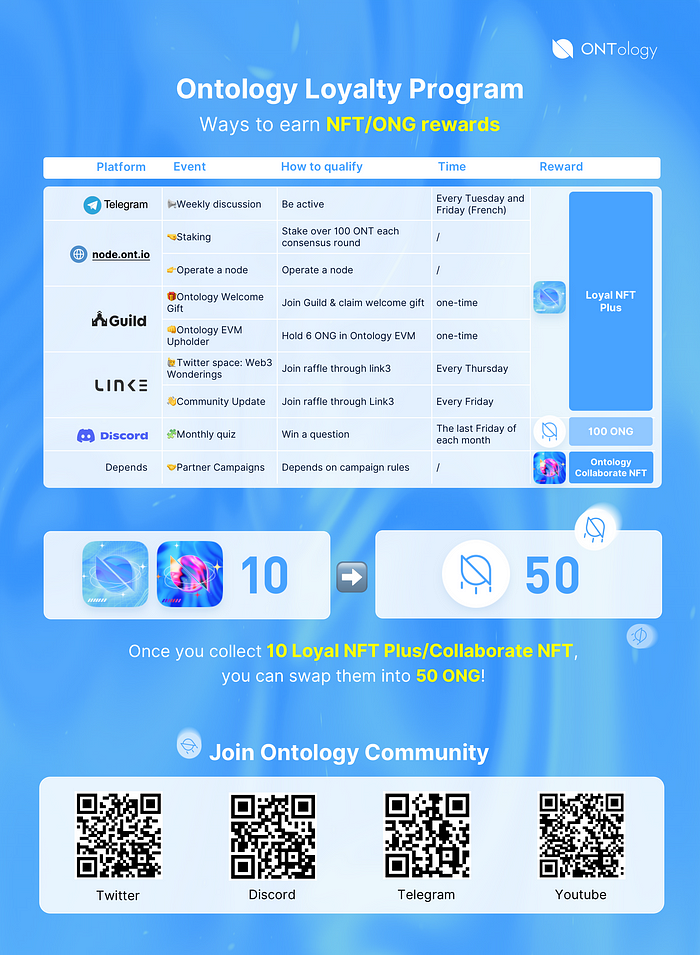
Loyal NFT Plus

- Earn Through Community Engagement: Join our Web3 Wonderings on Twitter, participate in Telegram discussions, and more to earn this exclusive NFT.
- Unique and Non-Transferable: This special NFT, residing on the Ontology chain, symbolizes your commitment and cannot be transferred.
 Ontology Collaborate NFT

- Earn Through Collaboration: Engage with us through partner programs like joint AMAs and giveaways.
- A Symbol of Partnership: This NFT, on the Ontology EVM chain, represents your collaborative spirit in our expanding ecosystem.
 Ways to Earn NFT & ONG Rewards
- Join Web3 Wonderings Twitter Spaces — Get 1 Loyal NFT Plus
 Be a part of our Twitter Spaces discussions, enter the link3 raffle, and earn your Loyal NFT Plus.
 - Participate in Telegram Discussions — Win Loyal NFT Plus
 Engage in our Telegram chats and stand a chance to win the Loyal NFT Plus.
 - Engage in Discord Monthly Quiz — Win 100 ONG
 Show off your knowledge and win a Loyal NFT Plus in our fun-filled monthly quizzes.
 - Stake over 100 ONT — Earn Loyal NFT Plus per Consensus Round
 Deepen your involvement in our ecosystem through staking and earn Loyal NFT Plus for each round.
 - Run a Node — Verify and Earn Loyal NFT Plus
 Support our network by running a node and get rewarded with a Loyal NFT Plus.
 - Collaborate in Ontology Partner Programs — Obtain Ontology Collaborate NFT
 Join us in partner events and earn the Ontology Collaborate NFT, showcasing your partnership with us.
Collect 10 NFTs? Claim your 50 ONG!  Gather 10 of either Loyal NFT Plus or Ontology Collaborate NFTs and claim 50 ONG as a reward for your dedication.
 Exciting Promotion Opportunities:
- Stay Engaged: Participate in our community events on Discord, Telegram, and Twitter.
- Keep Learning: Dive into our educational channels on Discord for more insights.
- Be Collaborative: Engage in our partner programs and contribute to our expanding network.
 Join the Ontology Loyalty Program Today! Double the NFTs, Double the Opportunities!
With the introduction of Loyal NFT Plus and Ontology Collaborate NFT, your journey with Ontology becomes even more rewarding. Be a part of our community, explore new possibilities, and enjoy the doubled opportunities to earn and learn in the world of Web3! 


]]>