We invite you to join us on what could be our greatest adventure to date, entering the Metaverse. Web3 will bring us together to game, invest, communicate, and innovate online. It will offer a world where we are self-sovereign and not simply a product which companies capitalize on by collecting our data. In the new era of the web, there can be a decentralized metaverse world where we have more control over our identity and our data.
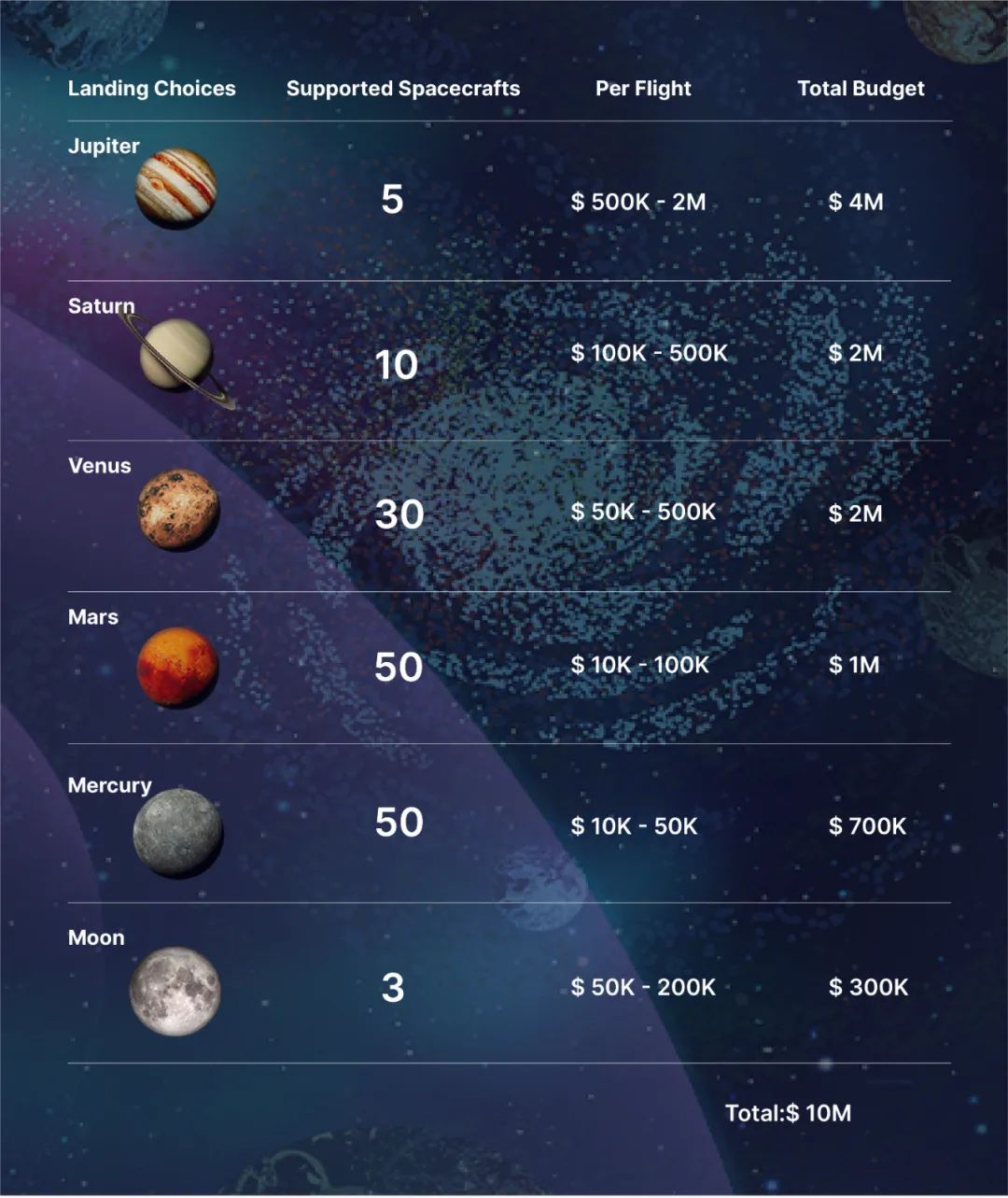
Fueled by the new Ontology EVM Fund, we can make this vision a reality. We have made $10 million equivalent funding available to support suitable projects who are working towards creating an incredible Metaverse that is open and decentralized. Of course, success on a new planet is not only dependent upon finances. That is why further to the support offered by the Ontology EVM Fund, developers will benefit from a Fast, Accessible, and Secure public chain with a focus on Decentralized Identity and Data. Projects also benefit from the growing user base of ONTO Wallet, which already has over 800k users, and the flagship identity solution, ONT ID, which has been created over 1.5 million times. Ontology offers projects the opportunity to achieve exposure by top level media outlets and the opportunity to join the crypto conversation with some of the leaders in the space.
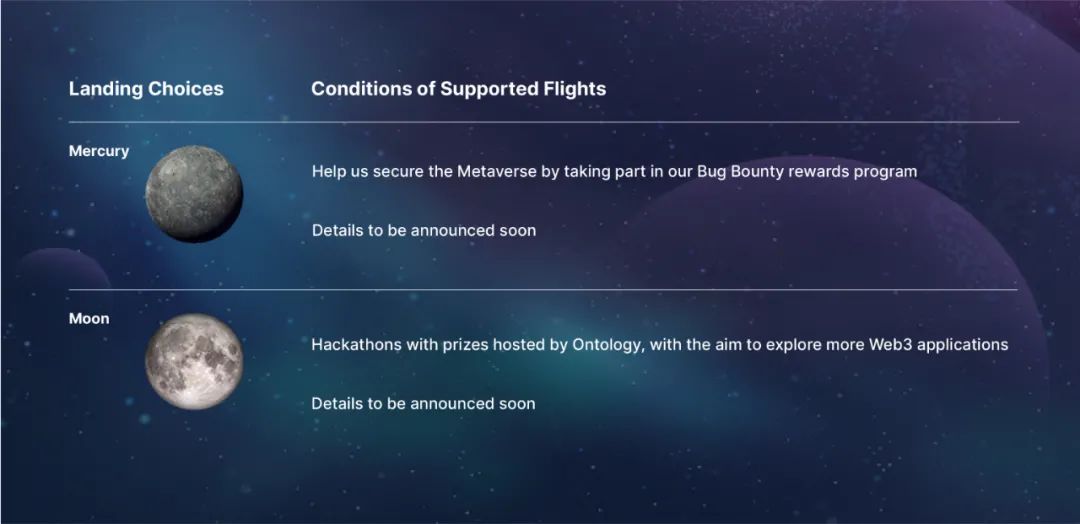
We think of these projects as spacecrafts, the driving force behind a shared mission and the stable vessel that holds collective explorers together. If you are one of these projects/spacecrafts, bring your crew to join us on an adventure. We have landing platforms prepared on Jupiter, Saturn, Venus, and Mars. Our ground crew is waiting to welcome you with the resources you need. Simply check out below to see which planet best suits your needs. 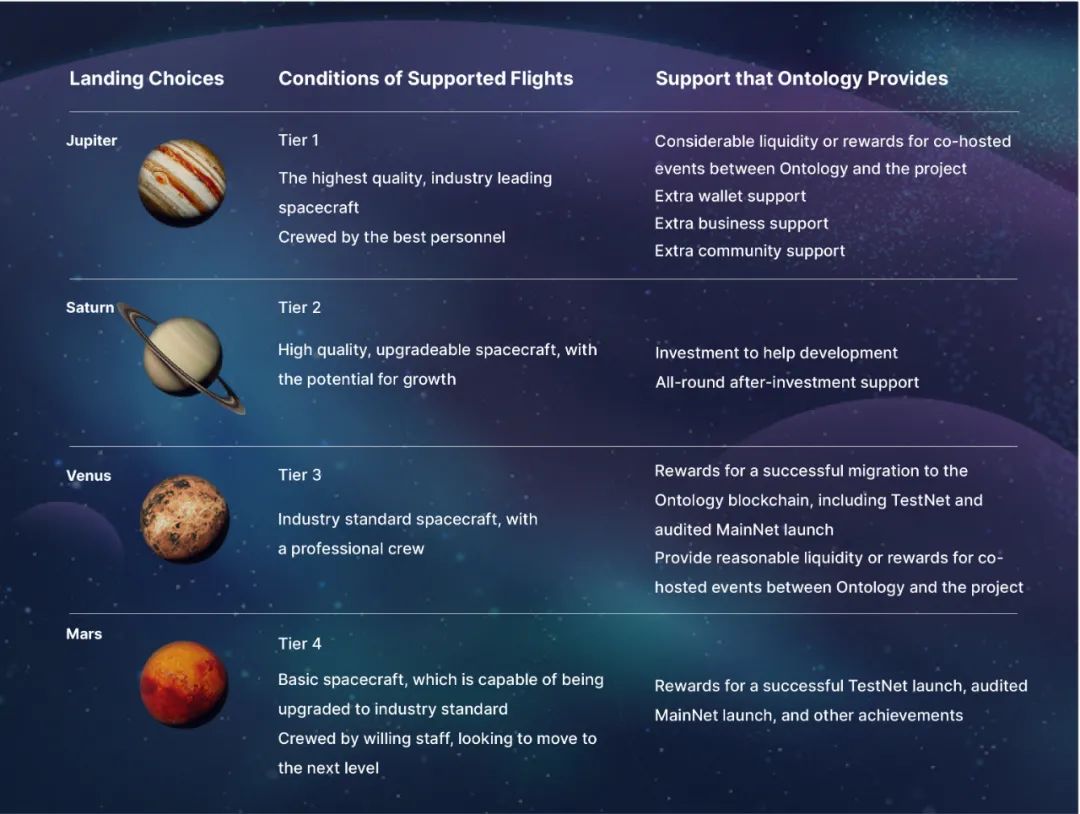 Should you possess an adventurous spirit, but not yet own a spacecraft and team, then do not fear. We have space on our public spacecraft where you can put your skills to use and be rewarded for your endeavors. These flights take you to Mercury and to the Moon, where you can take part in Bug Bounties and Hackathons. See the details below.
 So how can we support your adventurous spirit? What can we do to make our journey a success? What awaits you when you land on your planet of choice. Whilst we only have limited space available, each selected project will be eligible for rewards to help them succeed. See the landing and flight plans below.
 We are going to the Metaverse. Are you coming with us?
Submit your application to join us on our journey by proposing on the Ontology Community Forum.
Technical Reference
Links of tools and docs about the Ontology EVM:
- Ontology Bridge: https://bridge.ont.io/testnet/
- Ontology Explorer: https://explorer.ont.io/testnet
- EVM smart contract development doc: https://docs.ont.io/guides-and-tutorials/development-guides/smart-contract-dev/evm-contract
- Ontology EVM supported Web3 API: https://docs.ont.io/developer-tools/api/eth-web3-api
To celebrate the release, Ontology has also announced a $10 million USD (ONT/ONG equivalent) EVM Fund to support developers building Web3/Metaverse decentralized applications (dApps) on Ontology. As well as receiving investment and the potential to access Ontology’s state-of-the-art protocols and tools, participating projects can receive tech, marketing, and business development support. Ontology will receive equity/tokens in the projects, enabling the synergistic growth of its interoperable ecosystem across a diverse array of projects.
Ontology’s EVM will reduce migration costs for developers, allowing them to enter EVM-based ecosystems on the Ontology blockchain. This will enable lower gas fees, as the Ontology EVM uses ONG as the gas fee for on-chain services, which usually costs 0.05 ONG per transaction. Developers will also benefit from faster block production.
Ontology’s multi-virtual machines make it the most VM supported blockchain, including NeoVM, WasmVM and now EVM. The latest virtual machine will help to connect thousands of developers building on Ethereum to the Ontology blockchain. These developers will be able to build rapidly with Ontology’s decentralized identity and data protocols.
As we move into the next iteration of the internet, decentralized identity solutions and privacy preserving technology are becoming increasingly important for the secure expansion of decentralized networks. Ontology’s EVM will facilitate the creation of privacy preserving technologies within a more mainstream developer group. These developers will be able to leverage ONTO Wallet, the gateway for a seamless Web3 experience which has a base of 800K users, as well as ONT ID, Ontology’s decentralized digital identity application which reached over 1.5 million users last year.
Commenting on the development Li Jun, Founder of Ontology, said: “As we migrate to Web3 we have an opportunity to create a safer, fairer, more decentralized internet. By launching our EVM, Ontology is contributing to this vision by increasing cross-chain interoperability, as well as expanding our decentralized identity solutions to mainstream developers within EVM-based ecosystems through our EVM Fund. The fund hopes to contribute to the creation of a decentralized, secure and fully interoperable metaverse. For this reason, it will put a specific focus on metaverse and Web3 projects. The Ethereum network is an essential connection for Ontology given its extensive support of smart contract creation and decentralized application development, not least its position as a leader within the DeFi space and its extensive portfolio of world class developers.”
The EVM will increase Ontology’s functionality by adding an Ethereum account system, Ethereum transaction types, and Web3 APIs. The existing Ontology chain native assets can be transferred to dApps on the EVM for circulation without redevelopment, allowing for the seamless continuity of Ontology’s ecosystem development.
Dr Kendall MAO, Chief Scientist at Ontology, said: “Since the completion of our EVM development in June last year, it has gone through rigorous checks to ensure that developers will experience a seamless, secure integration upon its release today. In September, we opened the EVM compatible public beta to developers across the world, as well as launching a bounty program in collaboration with renowned security experts, SlowMist. Now fully audited, the machine will offer seamless interoperability to a host of new mainstream developers, as well as allowing them to enter the Ontology ecosystem with lower gas fees and faster block production.”
Any new or established dApp interested in the EVM Fund can apply and will be subject to evaluation from the Ontology community and team. Project submissions can be made through Ontology Community Forum.
]]>The Ontology EVM marks a pivotal moment in blockchain development, merging the realms of creativity with advanced blockchain technology. It’s a space designed for developers to delve into digital assets management, smart contracts, and decentralized identity solutions without facing the usual barriers. This initiative welcomes all—seasoned developers and Web3 novices alike—underscoring Ontology’s dedication to pushing the boundaries of Web3 innovations.
This environment goes beyond a mere testing ground. It’s a collaborative ecosystem where the community comes together to shape the future of digital identity with ONT ID, enable multi-chain collaborations, develop daring DeFi, and craft innovative NFTs. Ontology’s commitment to privacy and secure data exchange propels developers to contribute towards a balanced and just digital realm.
Your First Steps in Ontology EVM Development
Starting with the Ontology EVM is smooth and user-friendly, courtesy of the Bware Labs faucet. This portal provides developers with the necessary tokens to kickstart their projects, allowing for a focus on innovation and problem-solving rather than the initial setup hassles.
Armed with tokens, developers are free to explore a wide array of blockchain projects, leveraging Ontology’s seamless integration with Ethereum’s ecosystem. This blend of familiarity and innovation—enhanced by features like ONT ID and a strong stance on data sovereignty—sets the stage for groundbreaking Web3 explorations.
For developers seeking additional support or looking to deepen their understanding of decentralized identity and staking within Ontology’s ecosystem, StackUp provides a valuable resource. Through campaigns focused on decentralized identity and staking with Ontology, participants can gain insights, earn rewards, and engage with a community of like-minded individuals. This partnership underscores Ontology’s commitment to developer education and support, ensuring that every participant has the resources and community backing to innovate confidently.
Why Build on Ontology EVM?
The core of Ontology EVM’s appeal is its robust support for decentralized identity via ONT ID. This framework not only streamlines identity verification but also bolsters privacy and data sovereignty, key for secure Web3 ecosystems. Developing on the Ontology EVM places developers at the heart of creating a user-empowered digital environment.
Furthermore, the platform is a hub for innovation and collaboration, supporting a diverse range of digital assets, NFTs, DeFi projects, and cross-chain interoperability efforts. The community around Ontology EVM is a rich resource pool, encouraging rapid development and shared growth, vital for the advancement of blockchain technologies.
Empowering Your Development Journey
Ontology’s innovation ecosystem extends beyond the EVM. An extensive array of resources, including comprehensive documentation, SDKs, and APIs, is available to support developers at every project phase. These tools are tailored to demystify blockchain complexities, ensuring that developers of varying expertise can actualize their visions efficiently.
The Ontology community stands as a beacon of support, offering a platform for developers to exchange ideas, seek guidance, and overcome challenges together. This collective is a testament to Ontology’s vision of a collaborative and interconnected digital future.
A Canvas for Innovation
The Ontology EVM is not just a development platform; it’s an invitation to join a movement. It provides a canvas for developers to experiment, learn, and contribute to a safer, equitable, and forward-looking digital ecosystem. We urge you to seize this chance, immerse yourself in the resources and community support available, and begin shaping your impact on the digital future.
Why wait? The Ontology EVM offers more than blockchain development; it’s a gateway to the next wave of Web3 innovations, a community of thinkers, and a landscape of opportunities. It’s your chance to be part of a collective journey to redefine digital interactions, prioritizing privacy, security, and user sovereignty.
Join us in this thrilling adventure. The Ontology EVM serves as both a sandbox for your technical experiments and a vibrant ecosystem where your ideas can lead to significant impacts. Whether you’re crafting DeFi applications, intricate smart contracts, or solutions for digital identity, Ontology provides the foundation for your success.
As we venture forward, the potential for innovation is limitless. Each piece of code, every smart contract, and all developed dApps on the Ontology EVM contribute to a broader narrative. We’re not just building apps; we’re crafting a digital legacy that empowers, protects, and unites.
Together, let’s envision and build this new digital era. Dive into the Ontology EVM, harness blockchain’s transformative power, and become part of a community dedicated to positive change. Your sandbox for innovation is ready—filled with lessons to learn, growth to achieve, and contributions to make for tomorrow’s digital world.
Welcome to Ontology EVM, where your blockchain innovation journey begins. Let’s make something extraordinary.
]]>Ontology’s proactive approach, through the launch of the Ontology EVM, marks a significant milestone in enhancing cross-chain interoperability and bolstering the support for decentralized identity within the Web3 space. This strategic move is not just about facilitating smoother transactions or interactions between blockchains; it’s about creating a more connected, accessible, and efficient digital world. The benefits of such integration extend far beyond simple connectivity, offering tangible improvements in usability and accessibility for digital assets and decentralized identities.
If the concept of VMs or the importance of interoperability in the Web3 ecosystem is new to you, don’t worry! We’ve got you covered. We’re recapping our series diving deep into the benefits of EVMs, elucidating how they function as the backbone for interoperable and flexible blockchain networks. This series is a treasure trove of information for anyone looking to understand the critical role VMs play in the current and future landscape of blockchain technology. For a comprehensive overview, we invite you to check out the post below for a full recap, ensuring you’re up to speed with how these technologies are shaping a more secure and interconnected digital future.
Virtual Machines
VMs stand at the core of the blockchain revolution, not just as the backbone for deploying and managing decentralized applications (dApps) but also as essential facilitators of smart contract interoperability across diverse blockchain ecosystems. These VMs offer an isolated environment where smart contracts—agreements expressed as code executed on the blockchain—can operate securely and without interference. This secure execution environment ensures that data exchanges are safe and that the performance of applications is consistent, which is crucial for the reliability and trustworthiness of decentralized platforms.
A smart contract’s programming language is typically specific to its blockchain platform. However, the beauty of VMs lies in their ability to allow smart contracts written for one blockchain to be executed on another. This cross-chain functionality not only saves significant time and costs that would otherwise be spent on rewriting and testing new smart contracts for different platforms but also eliminates the need for developers to learn new programming languages for each blockchain ecosystem they work with.
By bridging these gaps, virtual machines serve as the linchpin of Web3, transforming decentralized platforms from theoretical concepts into practical solutions for the digital challenges of today. They ensure that the blockchain ecosystem remains a vibrant and interconnected space, where the seamless exchange of digital assets and the smooth execution of decentralized identities are not just possible but are executed with enhanced usability and accessibility. This positions VMs not merely as technical components but as critical enablers of a more secure, efficient, and interoperable digital future.
VMs & Developers
For dApp developers, the journey from concept to launch is filled with challenges, innovation, and ultimately, satisfaction when seeing the number of users grow. Imagine you’re such a developer, having recently launched a successful dApp on a leading public blockchain platform. As the user base expands, your thoughts naturally turn towards what’s next. How can you further innovate, reach more users, and tap into new opportunities? This is where the Ontology EVM, and VMs in general, play a crucial role.
The Ontology EVM is not just a tool; it’s a gateway to new horizons for innovation, especially in the realm of decentralized identity solutions. VMs empower developers by enabling the integration of their dApps into different blockchain platforms effortlessly, using programming languages they are already familiar with. This seamless integration facilitates the exploration of new ecosystems and the expansion of the dApp’s user base without the need to rewrite or retest the application on a new platform. Furthermore, VMs provide developers with access to a broader network, augmenting their computing power and allowing them to leverage these connections to create more sophisticated smart contracts and dApps.
By putting control back into the hands of users, developers utilizing the Ontology EVM can facilitate a level of digital interaction and asset management previously thought unattainable. The EVM’s compatibility with a variety of programming languages and standards ensures that developers have the flexibility and support necessary to bring their innovative projects to life, pushing the boundaries of what is possible in the Web3 space. This approach not only benefits developers by providing them with the tools and environment to innovate but also enriches the ecosystem with dApps that offer users more control, security, and efficiency in managing their digital identities and assets.
The Ethereum Virtual Machine
Ontology’s commitment to cross-chain interoperability and the comprehensive management of digital assets in a multi-chain future has taken a significant leap forward with the development and integration of the Ontology EVM. Recognized as the most popular and widely used VM, the EVM supports a vast array of dApps and is a pivotal component in enhancing the blockchain ecosystem’s connectivity and functionality.
The introduction of Ontology’s EVM is a game-changer for several reasons:
- Increased Interoperability with Ethereum: It bridges Ontology and Ethereum, allowing for seamless asset migration between the two blockchains. This level of interoperability is crucial for developers who wish to leverage the strengths of both platforms without the constraints of being tied to a single ecosystem.
- Access to EVM-Based Projects with Added Benefits: Users can now engage with EVM-based projects deployed on Ontology, enjoying the dual advantages of lower gas fees and faster block production. This not only enhances the user experience but also makes Ontology a more attractive platform for deploying Ethereum-compatible dApps.
- Support for Ethereum Developers: By integrating the EVM, Ontology extends its hand to Ethereum developers, inviting them to build upon Ontology’s robust decentralized identity and data protocols. This enables a new realm of possibilities for developers looking to incorporate Ontology’s unique features into their dApps.
- Functional Enhancements: The integration of the EVM into Ontology’s ecosystem brings with it an Ethereum account system, Ethereum transaction types, and Web3 APIs. These additions increase Ontology’s functionality, making it a more versatile and comprehensive platform for developers and users alike.
Ontology’s EVM represents a significant stride toward realizing a more integrated and efficient Web3 experience. By fostering a seamless transition and interaction between different blockchain ecosystems, Ontology enables the creation of more versatile and powerful dApps. This cross-compatibility is key to unlocking the full potential of blockchain technology, ensuring that Ontology remains at the forefront of the movement toward a more interconnected and accessible digital future.
Build with Ontology EVM
Ontology’s EVM is much more than a mere platform; it’s a vibrant community and a comprehensive suite of tools designed to empower developers to innovate and shape the future of blockchain applications, especially in the digital identity sector. As we continue to enhance the ecosystem around the EVM, including upgrades to the Ontology Blockchain Explorer, Developer Documentation Center, and Ontology EVM-supported Web3 API, we’re creating an environment that not only welcomes but actively encourages innovation and development.
Developers have the unique opportunity to utilize the Ontology Bridge to convert Ontology’s native OEP4 tokens into ORC20 tokens. This feature allows for seamless integration with popular wallets like MetaMask, further simplifying the process of deploying dApps on Ontology’s EVM. The bridge serves as a critical tool in the interoperability and flexibility that Ontology’s EVM aims to offer, breaking down barriers between blockchain ecosystems and making it easier for developers to bring their innovative projects to life.
Whether you’re a seasoned blockchain developer or just starting out, Ontology’s EVM and the supporting ecosystem offer a fertile ground for innovation, development, and the realization of visionary blockchain applications. We invite you to join us in this journey, contribute your unique insights and creativity, and together, shape the future of a more interconnected, decentralized digital world.
]]>On the third anniversary of Ontology’s MainNet launch, we announced that the development of Ontology EVM had been completed. The existing version adds the Ethereum account system, Ethereum transaction types, and Web 3 APIs. At the same time, the virtual machine layer and transaction pool are optimized and enhanced, and the blockchain browser is synchronized.
Below, we describe the design and development details.
Part 1: Ethereum Virtual Machine
EVM: General Introduction
Ethereum describes the Ethereum Virtual Machine (EVM) as a ‘single entity maintained by thousands of connected computers running an Ethereum client.’
It goes on to state:
The Ethereum protocol itself exists solely for the purpose of keeping the continuous, uninterrupted, and immutable operation of this special state machine; It’s the environment in which all Ethereum accounts and smart contracts live. At any given block in the chain, Ethereum has one and only one ‘canonical’ state, and the EVM is what defines the rules for computing a new valid state from block to block.
Ontology’s EVM: Introduction
The EVM developed by Ontology is a virtual machine compatible with the Ethereum ecosystem. It uses ONG as the gas fee for on-chain services and requires relatively low gas fee consumption. Our goal is to ensure that Ontology’s EVM is fully compatible with the Ethereum ecosystem.
Part 2: Design and Development Process
Goals
Ontology’s smart contract system adopts the multi virtual machine scheme and supports three kinds of contracts; Native contracts, NeoVM contracts, and Wasm contracts. Thanks to Ethereum’s strong community and ecosystem, adding EVM support for Ontology can facilitate more existing Ethereum ecosystem developers to use Ontology.
Our aim is to ensure frictionless interoperability between Ontology and Ethereum to reduce migration costs of developers, and at the same time, avoid significant changes to the existing platforms to ensure the continuity of the ecosystem development.
Development Process and Results
Our development process lasted over one month, with one iteration. Upon completion, Ontology and Ethereum can interoperate seamlessly with a high level of compatibility. Specific features: updated browser, supported Ethereum account system, infrastructure, RPC (remote procedure call), and additional Web 3 interfaces.
Enhancements:
1) Account System at the Ledger Level
The underlying ledger status of Ontology only stores contract data; account data is stored in various contract storage areas, including native ONT and ONG contracts. However, Ethereum ledger status consists of two layers of MPT. The first layer is the account status, including the Nonce (Number only used once), the Ethereum balance and the status root of the account data. The second layer is the key value pair data of the contract account. Due to the huge gap, adopting an Ethereum solution would lead to a large number of destructive updates to Ontology. Therefore, we opened up a storage space to store the Nonce and contract codes of accounts related to Ethereum transactions. The key value pair data of the contract account is consistent with Ontology, which not only takes into account the function of Ethereum, but also ensures the compatibility of Ontology itself.
2) Virtual Machine (VM)
Based on its existing multi-VM system, Ontology can easily add EVM support. Most of the instructions are exactly the same as those on the Ethereum platform, with a few EVM instructions suitable only for Ethereum, such as COINBASE and DIFFICULTY, which use default values on Ontology. Because they are rarely used in dApps, most contracts can be seamlessly migrated in practical applications. We provide support for Ontology EVM calls from existing NeoVM and Wasm virtual machines to facilitate the interaction between existing contract applications and EVM applications. At the same time, in order to avoid the expansion and bifurcation of EVM, we do not currently provide support for EVM cross virtual machine calls.
3) Transaction Structure
Ontology’s transaction structure is scalable and supports several transaction types on demand. We support Ethereum EIP-155 transactions on the basis of existing transaction types, so that the transactions issued by existing Ethereum ecosystem wallets are compatible with Ontology EVM.
4)Transaction Pool Updated
The order of Ethereum’s transaction record must be increased according to the Nonce value of the account. To ensure this feature, we maintain a list of EIP-155 transactions in the transaction pool. Only transactions meeting the conditions can be packaged into blocks.
5)Web 3 API
At present, Ontology EVM provides rich interfaces such as RESTful, JSON-RPC, and WebSocket. Since contract development tools, wallets and dApps in the Ethereum ecosystem all use Web 3 API, we developed an additional interface adaptation layer to support Web 3 API, ensuring contract development tools and wallets such as Truffle, Remix, and MetaMask, can be directly used for dApp development on Ontology.
Part 3: Advantages
With the launch of the Ontology EVM, users can access Ethereum applications and wallets in one place.
Developers can use contract development tools such as Truffle and Remix to realize seamless connections between two chains and experience a more compatible blockchain ecosystem.
Ontology contracts development has the following advantages:
- Contracts supported: industry-leading VM support; multi-VM includes four kinds of contracts (NeoVM, Native, Wasm, EVM).
- Fees and Velocity: Users can experience the Ethereum ecosystem on Ontology blockchain, with lower gas fees and faster block production.
- Wasm support: Wasm has performed excellently since its launch two years ago.
Part 4: Conclusion
When Multi-VM launched in 2020, the Ontology Technical team said:
In the field of blockchain, the goal of virtual machine (VM) technology is to create a smart contract execution environment suitable for all transactions. However, from a technical point of view, the efficiency of contract execution, the complexity of supported transactions and the ability of cross-system cooperation are all key factors. In this process, different VMs have different application scopes. Ontology Multi-VM is committed to meeting a wider range of transaction requirements, bringing higher execution efficiency and lower gas fees. The design and launch of Ontology EVM is an important aspect of this goal, which will bring more transaction scenarios.
On the basis of the underlying completed functions, more compatibility tests and enhancements of the Ethereum tool chain will be carried out in the future to further satisfy the requirements of trusted data interactions and bring more convenient and efficient experiences for developers and users.
]]>