Why This Matters
Transaction costs are one of the most significant barriers to blockchain adoption. For enterprises evaluating decentralized solutions, predictable and reasonable operational costs are essential for sustainable integration. For developers building the next generation of apps, lower gas prices mean more room to innovate and experiment.
Enhanced Accessibility: Lower transaction costs remove friction for new users and enterprises entering the ecosystem.
Developer Empowerment: Builders can deploy and test applications more cost-effectively, encouraging faster iteration.
Competitive Positioning: Ontology remains aligned with industry standards, offering compelling economics compared to other Layer 1 solutions.
Ecosystem Growth: Emerging apps benefit from a more cost-efficient environment, strengthening the overall Ontology ecosystem.
The upgrade is live now. Start building at ont.io
]]> Voting Period:
Start: 00:00 UTC, January 6
End: 00:00 UTC, January 9
The goal? Lower the cost of onchain transactions, improve usability for dApps, and unlock a smoother experience for developers and users across the ecosystem. With recent optimizations improving both consensus and gas handling, the network is ready for this change, without sacrificing performance or stability.
Lower gas = lower barriers. This proposal helps Ontology stay competitive with other L1s while empowering builders, users, and emerging dApps with a more cost-efficient environment.
 Node operators can vote now via OWallet. Every vote counts in shaping the next evolution of the Ontology network.
Note: The information below is for education only. It describes options, questions, and factors to consider.
Web3 security foundations
Blockchain in one sentence: a public ledger where many computers agree on the same list of transactions.
Private key: the secret that lets you move your coins. Whoever controls it controls the funds.
Self custody vs custodial: self custody means you hold the keys. Custodial means a platform holds them for you.
Choosing venues: exchanges and custodians
What people usually try to learn about a venue
- How customer assets are held and whether segregation is documented
- Whether the venue publishes proof of reserves and whether liabilities are discussed
- What governance or policy controls exist for large transfers
- How compliance, KYC/AML, and audits are described
- Incident history and the clarity of post-incident communications
- Withdrawal behavior during periods of stress
Common storage language
- Hot storage: internet-connected and convenient
- Cold storage: offline and aimed at reducing online attack surface
Trading and custody involve process and oversight. Public signals such as disclosures, status pages, and audit summaries help readers form their own view of venue risk.
Bridge security: moving across chains safely
Think of bridges as corridors, not parking lots. A bridge locks or escrows assets on one chain and represents them on another. Because value crosses systems, bridges can be complex and high-value points in the flow.
Typical points to check or ask about
- Official interface and domain
- Current status or incident notes published by the team
- Fee estimates and expected timing
- Any approvals a wallet is about to grant and to which contract
- Whether a small “test” transfer is supported and how it is verified
- How the project communicates delays or stuck transfers
- Whether there is a public pause or circuit-breaker policy
Terms that appear in bridge discussions
- Validator and quorum or multisig: several independent signers must approve sensitive actions
- Reentrancy: a contract is triggered again before it finishes updating state
- Toolchain: compilers and languages a contract depends on; versions and advisories matter
Movement across chains touches multiple systems at once. Understanding interfaces, messages, and approvals can help readers evaluate their own tolerance for operational complexity.
Stablecoins: reserves, design, and plans
What a “dollar on-chain” can be backed by
- Cash and short-term treasuries at named institutions
- Crypto collateral with over-collateralization rules
- Algorithmic or hybrid mechanisms
Questions readers often ask themselves
- What assets back the stablecoin and where are they held
- How concentration across banks, issuers, or designs is handled
- What signals would trigger a partial swap or a wait-and-see approach
- Which sources are monitored for updates during stress
Example elements of a personal depeg plan
- Signals: price levels or time thresholds that prompt a review
- Actions: small, incremental adjustments rather than all-or-nothing moves
- Sources: issuer notices, status pages, and established news outlets
Designs behave differently under stress. Defining personal signals and information sources ahead of time can make decisions more methodical.
Human layer protection: phishing, privacy, browser hygiene
Patterns commonly seen in phishing or social engineering
- Urgency or exclusivity, requests to “verify” a wallet, surprise airdrops
- Lookalike domains, QR codes from unknown accounts, unsigned or opaque transactions
- Requests for seed phrases or private keys (legitimate support does not request these)
Privacy points that often come up
- Use of a work or pickup address for hardware deliveries
- Awareness that marketing databases can leak personal details
Browser and device considerations people weigh
- A separate browser profile for web3 use with minimal extensions
- Regular device and wallet firmware updates
- For shared funds, whether a multisig or policy-based account would add useful checks
Many losses begin with human interaction rather than code. Recognizing common patterns can help readers evaluate messages and prompts more calmly.
Web3 security glossary
Bridge: locks an asset on chain A and issues a representation on chain B
Wrapped token: an IOU on one chain representing an asset on another
Oracle: external data or price feed for smart contracts
Reentrancy: re entering a contract before the state updates which can enable over withdrawal
Multisig or quorum: multiple keys must sign before funds move
Proof of reserves: an attestation that holdings cover obligations and is meaningful only if it includes liabilities
Self custody: you hold the private keys which brings more responsibility and less venue risk
Cold storage: offline key storage that is safer from online attack
KYC or AML: identity and anti money laundering controls
Seed phrase: the words that are your wallet. Anyone with them can empty it
Important definitions
Keys
- Where are long-term funds held
- Is there a way to verify address and network before larger transfers
- Is a small confirmation transfer practical in the current situation
Approvals
- Which contracts currently have spending permission
- Are there tools to review or remove old allowances if desired
Bridges
- Is the interface official and the status normal
- Are there recent notices about delays or upgrades
- If something looks off, where are the official communications checked
Monitoring
- Which status pages are bookmarked for wallets, bridges, and venues
- Which channels are considered primary for updates during turbulence
Venues
- Is there public information on liabilities alongside assets
- How are customer assets segregated according to the venue
- What governance and audit information is available
Comms hygiene
- How are links verified before use
- What is the process when receiving unexpected DMs or QR codes
- What information will never be shared (for example, seed phrases)
Playbooks
- What are the personal thresholds for a stablecoin price review
- What are the steps if an exchange pauses withdrawals
- What is the process if a wallet compromise is suspected
Note for readers
This article is an educational takeaway from our community call. The full call is on X here. It is not advice. It is meant to help readers develop their own questions, checklists, and comfort levels when using web3 tools.
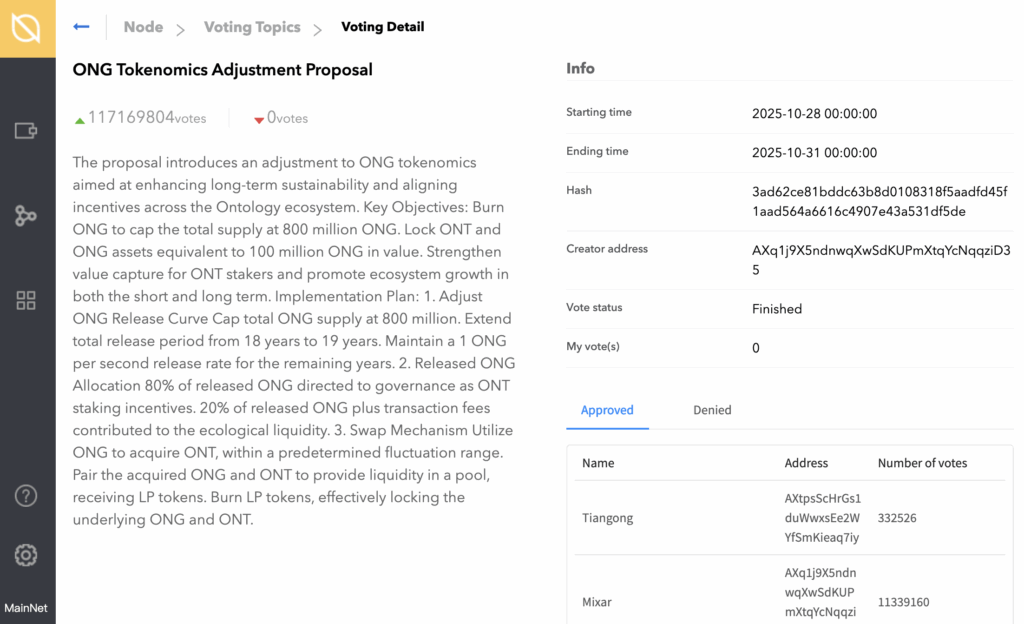
]]>After three days of voting, from October 28 to October 31, 2025 (UTC), Ontology Triones Nodes reached a unanimous decision in favor of the proposal. The proposal secured over 117 million votes in approval, signaling strong consensus within the network to move forward with the next phase of ONG’s evolution.
A Vote for Long-Term Sustainability
This proposal represents a significant step in refining ONG’s tokenomics to ensure long-term stability, strengthen staking incentives, and promote sustainable ecosystem growth.
Here’s a quick recap of what’s changing and why it matters.
Key Objectives
- Cap total ONG supply at 800 million.
- Lock ONT and ONG equivalent to 100 million ONG in value to strengthen liquidity and reduce circulating supply.
- Rebalance incentives for ONT stakers while ensuring long-term token sustainability.
- ONG Max and Total Supply will decrease from 1 billion to 800 million, with 200 million ONG burned immediately.
- ONG Circulating Supply remains unchanged immediately after the event; however, circulating supply could drop to around 750 million (assuming that 1 $ONG = 1 $ONT) in the future due to the permanent lock mechanism.
Implementation Plan
- Adjust ONG Release Curve
- Cap total supply at 800 million ONG.
- Extend total release period from 18 to 19 years.
- Maintain a consistent 1 ONG per second release rate for the remaining years.
- Released ONG Allocation
- 80% of released ONG will continue to flow to governance as ONT staking incentives.
- 20%, plus transaction fees, will be contributed to ecological liquidity.
- Swap Mechanism
- ONG will be used to acquire ONT within a set fluctuation range.
- The acquired ONG and ONT will be paired to provide liquidity and generate LP tokens.
- LP tokens will be burned, permanently locking the underlying assets to maintain supply discipline.
Community Q&A Highlights
Q1. How long will the ONT + ONG (worth 100 million ONG) be locked?
It’s a permanent lock.
Q2. Why extend the release period if total ONG supply decreases?
Under the previous model, the release rate increased sharply in the final years. By keeping the release rate steady at 1 ONG per second, the new plan slightly extends the schedule — from 18 to roughly 19 years — while maintaining predictable emissions.
Q3. Will ONT staking APY be affected?
Rewards will shift slightly, with ONG emissions reduced by around 20%. However, as ONG becomes scarcer, its market value could rise, potentially offsetting or even improving overall APY.
Q4. What does this mean for the Ontology ecosystem?
With the total supply capped and 200 million ONG burned immediately, and 100 million $ONG equivalent-valued $ONG and $ONT permanently locked, effective circulating supply could drop to around 750 million (assuming that 1 $ONG = 1 $ONT). This scarcity, paired with ongoing ONG utility and swapping mechanisms, should strengthen market dynamics and improve long-term network health.
Q5. Who was eligible to vote?
All Triones nodes participated via OWallet, contributing to Ontology’s decentralized governance process.
The Vote at a Glance
| Proposal | ONG Tokenomics Adjustment |
|---|---|
| Voting Period | Oct 28–31, 2025 (UTC) |
| Vote Status |  Approved Approved |
| Total Votes in Favor | 117,169,804 |
| Votes Against | 0 |
| Status | Finished |
What Happens Next
With the proposal approved, the Ontology team will begin implementing the updated tokenomics plan according to the outlined schedule. The gradual rollout will ensure stability across the staking ecosystem and DEX liquidity pools as the new mechanisms are introduced.
This marks an important milestone in Ontology’s ongoing effort to evolve its token economy and strengthen decentralized governance.
As always, we thank our Triones nodes for participating and shaping the direction of the Ontology network.
Stay tuned for implementation updates and the next phase of Ontology’s roadmap.
]]>