For builders and projects, this has created a new challenge:
distribution is no longer just about reach, it’s about trust, context, and quality of engagement.
ONTO Wallet’s evolution over the last 12 months offers a useful lens into where Web3 distribution is heading, and what partners should now expect from the platforms that sit between products and users.
From Reach to Relevance
In earlier phases of Web3, distribution often meant visibility at any cost. The assumption was simple: more users, more wallets, more impressions.
That model is breaking down.
As the ecosystem matures, users are more cautious, regulators are more attentive, and projects are more selective about where and how they onboard new participants. The signal-to-noise ratio matters.
ONTO’s development over the past year reflects this shift. Rather than optimising for volume alone, the focus has been on reducing friction, clarifying risk, and supporting informed exploration.
For partners, this signals a move away from raw exposure toward relevant, trust-aligned distribution.
Why Abstraction Is Now Table Stakes
Multi-chain is no longer a future state, it’s already the present. But while infrastructure has advanced quickly, user experience has lagged behind.
The work done inside ONTO to simplify multi-chain interaction, from clearer transaction summaries to smoother swaps and bridges, highlights an important reality for integrators:
If users have to understand your infrastructure to use your product, adoption will stall.
Abstraction is not about hiding complexity; it’s about owning it on behalf of users. Distribution platforms that fail to do this will increasingly become points of friction rather than enablers.
Trust Is a Product Feature
Security and identity are often discussed as compliance requirements or backend concerns. In practice, they are central to whether users feel confident engaging with new products at all.
ONTO’s emphasis on visible risk indicators, clearer approval management, and optional identity integrations reflects a broader shift:
Trust is no longer implied, it must be continuously reinforced.
For partners, this has two implications:
- Users are more likely to engage when risk is clearly communicated
- Platforms that surface trust signals reduce onboarding friction for everyone downstream
Ontology’s work on decentralized identity and verification underpins this approach, enabling trust to be applied where it matters, without becoming a barrier everywhere else.
Discovery as a Shared Responsibility
As the number of Web3 projects grows, discovery becomes a bottleneck — not because of scarcity, but because of overload.
ONTO’s evolution toward a more curated discovery experience reflects an important change in how distribution platforms are expected to behave. The role is no longer neutral plumbing; it is active guidance.
For projects, this changes the value of integration:
- Discovery is contextual, not random
- Users arrive with a clearer understanding of what they are engaging with
- Early access is paired with learning and expectation-setting
This results in higher-quality engagement, rather than transient attention.
What This Means for Partners
The maturation of ONTO Wallet is not an isolated product story. It is a signal of how Ontology views the future of Web3 distribution:
- Fewer, more meaningful integrations
- Users who explore intentionally, not opportunistically
- Trust and identity applied purposefully, not performatively
- Distribution that supports learning, not just liquidity
For partners, integrating into ONTO is not simply about being listed inside a wallet. It is about participating in an environment designed to reduce friction, align incentives, and support sustainable user engagement.
Looking Ahead
As Web3 continues to evolve, the platforms that succeed will be those that treat trust, abstraction, and discovery as first-class responsibilities, not afterthoughts.
Ontology will continue building the infrastructure that enables this shift, while ONTO delivers it in practice through real user experience.
For projects looking to reach users who are early, curious, and increasingly selective, the question is no longer whether distribution matters, but what kind of distribution you are choosing.
Work With Ontology
If you are building a Web3 product and are exploring:
- Wallet-based distribution
- Identity-enabled access or verification
- Early user discovery with clearer trust signals
We’re open to conversations about how integration into the Ontology ecosystem, including ONTO Wallet, can support your goals.
Learn about integrating with ONTO
]]>December marked a busy close to the year, with important infrastructure updates, ecosystem milestones, and community conversations across Ontology, ONTO Wallet, and the wider network. Below is a structured overview of what happened and why it mattered.
Ontology Network Updates
December focused heavily on infrastructure stability, long-term sustainability, and ecosystem alignment.
Early in the month, Ontology issued a mandatory MainNet v3.0.0 upgrade notice, requiring node operators to update by December 3 to avoid network disruption. This upgrade was accompanied by planned ONG supply adjustments around December 15, reinforcing Ontology’s commitment to predictable and transparent network operations.
To mark Ontology’s 8th anniversary, the team hosted a series of community discussions, including special Privacy Hour X Spaces focused on ecosystem progress and future direction, as well as Community Connect Spaces covering anniversary updates and broader Web3 trends.
December also saw Ontology join the Circle Alliance Program, opening the door for deeper collaboration around on-chain economies powered by USDC.
Additional highlights included:
- Publication of the House of ZK report, covering MainNet upgrades and ecosystem developments
- A new Consensus Round 266 summary, outlining yield performance and staking growth
- Announcement of Ontology & Me campaign winners, distributing 1,000 ONG based on community voting
- Launch of Ontello Beta, introducing a new social Web3 application with encrypted messaging and AI agents
Community Spaces in December
These conversations offered insight into both technical developments and broader ecosystem direction.
ONTO Wallet Highlights
December was also an active month for ONTO Wallet, with a strong focus on discovery, trading activity, and community participation.
ONTO published its 2025 Year in Review, reflecting on the product’s evolution into a trusted Web3 discovery wallet designed to help users explore projects with greater clarity and confidence. This was complemented by the launch of the Year in Review feature inside the app, along with a community sharing campaign offering rewards of up to 100 USDT.
ONTO also announced an official partnership with Changelly, expanding exchange options inside the wallet. The integration is scheduled to go live in January, with related campaigns to follow.
Trading activity remained strong throughout the month, including:
- Final leaderboards and winner announcements for the ONTO x Exolix Trading Competition
- Multiple trading lucky draw campaigns with rewards in USDT and ONG
- A new Exolix trading campaign offering a total prize pool of 4,400 USDT
In parallel, ONTO continued community education efforts, publishing guidance on non-custodial wallet security and promoting discussions on building sustainable Web3 communities.
Network Activity Snapshot
As of December, the Ontology network has processed:
20,149,529 total transactions and over 200 million ONT has been staked.
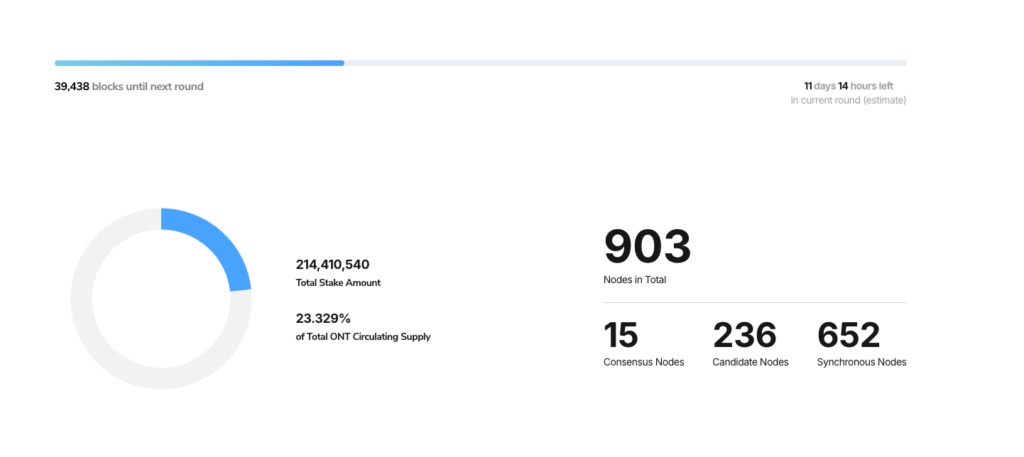
This milestone reflects continued on-chain usage across the ecosystem.
Looking Ahead
As the year comes to a close, Ontology remains focused on infrastructure reliability, responsible ecosystem growth, and long-term engagement models. More updates on upcoming initiatives and community programs will be shared in the new year.
Thank you for being part of the Ontology ecosystem. We look forward to continuing the journey together in 2026.
]]> Voting Period:
Start: 00:00 UTC, January 6
End: 00:00 UTC, January 9
The goal? Lower the cost of onchain transactions, improve usability for dApps, and unlock a smoother experience for developers and users across the ecosystem. With recent optimizations improving both consensus and gas handling, the network is ready for this change, without sacrificing performance or stability.
Lower gas = lower barriers. This proposal helps Ontology stay competitive with other L1s while empowering builders, users, and emerging dApps with a more cost-efficient environment.
 Node operators can vote now via OWallet. Every vote counts in shaping the next evolution of the Ontology network.
This three-part series highlights the winning articles from each week of the competition:
- Week 1: What Is Account Abstraction?
- Week 2: What Are Smart Accounts?
- Week 3: How Smart Accounts and Account Abstraction Fit Together
Together, these pieces explain how programmable wallets and decentralized identity are redefining ownership, usability, and trust across Web3.
Read on to discover how our community sees the future of blockchain. Smarter, safer, and built for everyone.
What is Account Abstraction? The Bridge to Web3 Mass Adoption
Article by Proxyma
Imagine trying to send an email but first having to manually configure SMTP servers, manage encryption keys, and pay postage fees in a specific currency you don’t own. This is essentially what Web3 feels like today. Account Abstraction (AA) promises to change that, making blockchain interactions as seamless as using Gmail.
The Current Problem: Web3’s User Experience Crisis
Today’s Ethereum wallets rely on Externally Owned Accounts (EOAs) accounts controlled by a single private key. While groundbreaking for decentralization, EOAs create massive friction:
- Gas Token Dependency: You must hold ETH to pay fees, even for simple token transfers
- Single Point of Failure: Lose your seed phrase, lose everything forever
- Complex Interactions: Each transaction requires manual approval and gas estimation
- Poor Recovery: No built-in way to recover lost accounts
These limitations explain why Web3 remains challenging for mainstream users. Account Abstraction addresses these pain points by reimagining how accounts work entirely.
What is Account Abstraction?
Account Abstraction transforms user accounts from simple private key wallets into programmable smart contracts. Instead of being bound by EOA limitations, Account Abstraction allows accounts to define custom logic for authentication, fee payment, and transaction execution.
Think of it as upgrading from a flip phone to a smartphone, the core functionality remains, but possibilities expand dramatically.
How Account Abstraction Works
Smart Contract Wallets
Instead of being tied to a private key, Account Abstraction uses a smart contract that acts as your account. This smart contract holds your tokens and assets while containing custom logic for managing the account.
ERC-4337: The Technical Foundation
The primary technical implementation of Account Abstraction comes through EIP-4337, which enables Account Abstraction without changing Ethereum’s core protocol. Here’s the simplified flow:
- UserOperations: Users create “UserOperations” containing their intended actions like token transfers.
- Bundlers: Special actors collect UserOperations and submit them in bundles.
- EntryPoint Contract: A singleton contract that validates and executes operations.
- Smart Wallets: Execute the actual transactions based on their programmed logic.
An in-depth explanation on the abstraction process can be found on this Proposal.
Paymasters: The Game Changer
Paymasters are entities that can sponsor transaction fees, enabling gasless transactions. A dApp can pay your gas fees, or you can pay in USDC instead of ETH.
Key Benefits of Account Abstraction for Users
Gasless Transactions
- Enables users to pay fees in any token (USDC, DAI, etc.)via paymaster.
- dApps can sponsor your transaction costs.
- No need to hold ETH for every interaction.
Social Recovery
Set up recovery procedures with trusted contacts or services. Lost your keys? Your designated recovery guardians can help restore access, no more permanent fund loss.
Customized Security
- Multi-signature requirements
- Spending limits for large transactions
- Time delays for high-value transfers
- Biometric authentication (Face ID, Touch ID)
Improved User Experience
- Session Keys: Authorize games to make small purchases automatically.
- Transaction Bundling: Execute multiple operations in one confirmation.
- Automated Execution: Set up recurring payments or trading strategies.
- One-Click Onboarding: Start using Web3 without seed phrases.
Real-World Applications
Gaming: Players authorize a game for micro-transactions within set limits, eliminating constant wallet confirmations while maintaining security.
DeFi: Users set automated strategies like “swap to stablecoins if my portfolio drops 20%” without keeping devices online.
E-commerce: Shoppers pay with any token they own, while merchants receive their preferred currency all sponsored by the platform.
Enterprise: Companies implement multi-department approval workflows for large transactions.
Current Implementation & Tools
- Coinbase Smart Wallet: Mainstream-friendly onboarding.
- UniPass: Actively enhancing Account Abstraction capabilities in partnership with Keystone.
- Biconomy: Developer infrastructure for gasless experiences
- Alchemy’s Account Kit: Tools for building Account Abstraction-enabled dApps
Layer 2 networks like Polygon and Arbitrum are optimizing specifically for smart contract wallets, making AA transactions faster and cheaper.
The Road Ahead
While ERC-4337 works today, additional proposals could enhance Account Abstraction:
- EIP-3074: Allows existing EOAs to delegate control to smart contracts
- EIP-7702: Proposes native account abstraction at the protocol level
These aren’t competing solutions but complementary approaches that could coexist, providing migration paths for existing users.
Why This Matters for Web3 Adoption
Account Abstraction represents Web3’s evolution from a power-user tool to a mainstream platform. Current barriers preventing mass adoption. Complex key management, mandatory gas tokens, poor recovery options are solved by Account Abstraction.
The infrastructure is maturing rapidly. What took Web2 decades to develop (user-friendly authentication, payment flexibility, account recovery) can now be built into Web3 from the ground up.
Conclusion: The Account Abstraction Revolution
Account Abstraction isn’t just a technical upgrade, it is the bridge between Web3’s technical sophistication and mainstream usability. By making accounts programmable, we unlock user experiences that rival traditional applications while maintaining blockchain’s core benefits: self-custody, transparency, and decentralization.
The question isn’t whether Account Abstraction will succeed, major wallets and dApps are already implementing it. The question is how quickly the entire ecosystem will embrace this paradigm to build truly user-friendly Web3 experiences.
As we move toward blockchain interactions as seamless as using any modern app, Account Abstraction stands as the critical infrastructure making that future possible. Web3’s next billion users won’t need to understand private keys, gas fees, or seed phrases, they’ll just use applications that happen to be decentralized.
How Smart Accounts Are Reinventing The Web3 Wallet
Article by Lahiru890
If you’ve ever used a crypto wallet like MetaMask, you’ve used an externally owned account (EOA). It’s a simple pair of keys: a public address that acts as your identity and a private key that proves you own it. This model is powerful but rigid, putting the entire burden of security and complexity on the user. Lose your seed phrase? Your funds are gone forever. Find transactions confusing? The ecosystem has little flexibility to help.
A new standard is emerging to solve these problems, moving us from rigid key-based wallets to programmable, user-friendly interfaces. The answer is smart accounts.
What is a smart account?
A smart account (or smart wallet) is not controlled by a single private key. Instead, it is a smart contract that acts as your wallet. This shift from a key-based account to a contract-based account is revolutionary because smart contracts are programmable. They can be designed to manage assets and execute transactions based on customizable logic, enabling features that were previously impossible.
This transition is powered by account abstraction (AA), a concept that “abstracts away” the rigid requirements of EOAs, allowing smart contracts to initiate transactions. While the idea isn’t new, it recently gained mainstream traction thanks to a pivotal Ethereum standard: EIP-4337.
EIP-4337 (the game changer)
EIP-4337: Account Abstraction via Entry Point Contract achieved something critical: it brought native smart account capabilities to Ethereum without requiring changes to the core protocol. Instead of a hard fork, it introduced a higher-layer system that operates alongside the main network.
Here’s how it works:
- UserOperations: You don’t send a traditional transaction. Instead, your smart account creates a UserOperation — a structured message that expresses your intent.
- Bundlers: These network participants (such as block builders or validators) collect UserOperation objects, verify their validity, and bundle them into a single transaction.
- Entry Point Contract: A single, standardized smart contract acts as a gatekeeper. It validates and executes these bundled operations according to the rules defined in each user’s smart account.
This system is secure, decentralized, and incredibly flexible.
Other key proposals (EIP-3074 and EIP-7702)
The journey to account abstraction has involved other proposals, each with different approaches.
- EIP-3074: This proposal aimed to allow existing EOAs to delegate control to smart contracts (called invokers). While simpler in some ways, it raised security concerns due to the power given to invoker contracts. It has since been paused.
- EIP-7702: Proposed by Vitalik Buterin, this upgrade would allow an EOA to temporarily grant transaction permissions to a smart contract. It offers a more elegant and secure model than EIP-3074 and may complement — rather than replace — the infrastructure built around EIP-4337.
For now, EIP-4337 is the live standard that developers and wallets are adopting.
Why smart accounts matter
The real value of smart accounts lies in the user experience and security improvements they enable.
- Gas abstraction: Apps can pay transaction fees for their users or allow payment via credit card, removing a major barrier to entry.
- Social recovery: Lose your device? Instead of a single seed phrase, you can assign “guardians” — other devices or trusted contacts — to help you recover access.
- Batch transactions: Perform multiple actions in one click. For example, approve a token and swap it in a single transaction instead of two.
- Session keys: Grant limited permissions to dApps. A game could perform actions on your behalf without being able to withdraw your assets.
- Multi-factor security: Require multiple confirmations for high-value transactions, just like in traditional banking.
The future is programmable
Smart accounts represent a fundamental shift in how we interact with blockchains. They replace the “all-or-nothing” key model with programmable, flexible, and user-focused design. Major wallets like Safe, Argent, and Braavos are already leading the way, and infrastructure from providers like Stackup and Biconomy is making it easier for developers to integrate these features.
We’re moving beyond the era of the seed phrase. The future of Web3 wallets is smart, secure, and designed for everyone.
How Smart Accounts and Account Abstraction Fit Together
Article by Nilmi Sugandhika879
Since the dawn of Ethereum, interacting with blockchains has meant using Externally Owned Accounts (EOAs) – simple wallets controlled by a private key. While functional, EOAs expose serious limitations: lose your key, and you lose your funds. Want features like spending limits, session keys, or social recovery? You’re left with clunky, layered workarounds.
Enter Account Abstraction (AA) and Smart Accounts. Together, these innovations are transforming how users engage with Web3 by merging the flexibility of smart contracts with the usability of traditional wallets. Instead of thinking about wallets as rigid containers of keys, we can now imagine them as programmable, customizable gateways into the blockchain world.
This article explores how Smart Accounts and Account Abstraction fit together, referencing key Ethereum proposals EIP-4337, EIP-3074, and EIP-7702 and why this combination is essential for building the next wave of user-friendly, secure, and innovative blockchain applications.
What is Account Abstraction?
Account Abstraction is the idea of treating all blockchain accounts as programmable entities. Instead of separating EOAs (controlled by private keys) and contract accounts (controlled by code), AA allows accounts themselves to act like smart contracts.
Key benefits of AA include:
- Gas abstraction: Pay transaction fees in tokens other than ETH.
Programmable security: Add multi sig, time locks, or social recovery. - Batched transactions: Execute multiple actions in one click.
Session keys: Grant temporary permissions for games or dApps. - Upgradability: Evolve wallet logic without replacing accounts.
With AA, wallets evolve from being passive key holders into active smart entities capable of executing logic on behalf of their users.
What are Smart Accounts?
If Account Abstraction is the theory, Smart Accounts are the practice. A Smart Account is simply a blockchain account that operates under the AA model.
Instead of relying on a single private key, a Smart Account:
- Runs customizable logic like a smart contract.
- Supports flexible authentication methods (biometrics, passkeys, hardware modules).
- Allows advanced features such as automatic payments, subscription models, or delegated access.
- Provides recoverability through trusted guardians or social recovery mechanisms.
In short, Smart Accounts are the user-facing manifestation of Account Abstraction. They bring abstract design principles into tangible experiences, making Web3 more accessible for everyday users.
How They Fit Together
Think of Account Abstraction as the architectural blueprint and Smart Accounts as the actual buildings.
AA defines the rules
- It sets the framework for programmable accounts.
- Proposals like EIP-4337 specify how transactions are validated and bundled without relying solely on EOAs.
Smart Accounts implement the rules
- They apply those AA rules to create practical wallets.
- Through smart contracts, they support features like gasless transactions, account recovery, and key rotation.
Together, AA and Smart Accounts replace the outdated key-wallet model with a flexible, modular system where user experience comes first.
The Role of Key EIPs
Ethereum’s progress toward AA and Smart Accounts has been guided by several proposals:
- EIP-4337 (2021):
Introduced the concept of a “UserOperation” and “bundlers.” This allows smart accounts to function without requiring changes at the consensus layer. It is the backbone of today’s AA-compatible wallets. - EIP-3074:
Enables EOAs to delegate control to contracts temporarily, bridging the gap between old wallets and smart accounts. - EIP-7702 (2024):
Builds on 3074 but provides a safer and more streamlined way for EOAs to transition into smart accounts. This is critical for onboarding existing users without forcing them to abandon their current wallets.
Together, these proposals ensure that Smart Accounts are not just theoretical they’re backward-compatible, forward-looking, and ready for mainstream adoption.
Why This Matters for Users
For users, the combination of AA and Smart Accounts translates into real-world improvements:
- Safety: Lose your key? No problem recover your wallet using guardians or multi-sig setups.
- Simplicity: Pay fees with stablecoins, batch multiple dApp actions into one transaction, or play a blockchain game without constant wallet prompts.
- Flexibility: Switch security models as your needs change (e.g., from a simple wallet as a beginner to a multi sig or hardware protected wallet as your assets grow).
- Innovation: Developers can build richer applications subscription based dApps, automated DeFi strategies, or Web3-native identity systems.
This shifts the user experience from fear of making mistakes to freedom to explore.
A Fresh Perspective: Smart Accounts as Digital Personas
One way to think creatively about Smart Accounts is to view them not just as wallets, but as digital personas.
Just as you might have different identities in real life personal, professional, or gaming Smart Accounts allow you to manage multiple digital personas:
- A DeFi persona with automated trading strategies.
- A gaming persona with session keys and gasless interactions.
- A professional persona tied to your DAO contributions.
Each persona can run its own logic while remaining linked to your overall identity. This flexibility makes Web3 personalized and intuitive, much like the evolution from simple feature phones to today’s smartphones.
Practical Takeaways for the Community
- Developers: Start experimenting with Smart Account SDKs built on EIP-4337. Building dApps with native AA support will set you apart in the next wave of adoption.
- Users: Explore AA wallets like Safe, ZeroDev, or Soul Wallet. Get familiar with recovery options and gas abstraction to see the difference firsthand.
- Communities: Advocate for dApps that integrate Smart Accounts, since these models reduce onboarding friction for newcomers.
By engaging now, the community can shape how AA and Smart Accounts evolve, ensuring they remain inclusive, secure, and user first.
Conclusion
Smart Accounts and Account Abstraction are not isolated innovations they are two halves of the same revolution. Account Abstraction lays the foundation, while Smart Accounts bring it to life. Together, they unlock a Web3 experience that is safer, simpler, and infinitely more flexible than today’s wallet paradigm.
Just as the smartphone redefined what we expect from communication devices, Smart Accounts will redefine what we expect from blockchain wallets. They are not just tools to hold assets they are programmable, adaptable, and deeply human centric gateways into the decentralized world.
The future of Web3 isn’t just about protocols or assets it’s about empowering people with smarter, safer, and more intuitive digital identities. And that future begins with Smart Accounts powered by Account Abstraction.
Delve Deeper With Ontology
Interested in how Account Abstraction and Smart Wallets are going to change your Web3 experience Learn More: https://ont.io/news/https-ont-io-news-smart-wallets-account-abstraction/
Get started with ONTO Wallet today: onto.app
]]>Stablecoins are everywhere. They’re powering remittances, cross-border commerce, crypto payroll, and even merchant checkout systems. From Stripe to Shopify to major exchanges, stablecoin adoption is accelerating.
But while blockchains have solved the problem of speed and cost, they’ve quietly ignored the biggest bottleneck in real-world use: identity.
If stablecoins are going to scale globally, across regions, merchants and users, they need more than fast rails. They need a decentralized identity layer.
The Problem With Stablecoin Compliance Today
Most stable coins weren’t built with compliance in mind. And now that they’re being used in payments, cracks are showing.
- Merchants don’t know who they’re accepting money from
- Platforms are duct-taping KYC providers into apps
- Users go through verification again and again
- There’s no standard for crypto KYC that works across wallets, bridges, and dApps
The result? A fragile trust layer built on centralized data silos and repetitive identity checks. The exact same problems crypto was supposed to solve.
Stablecoin Payments Need Verifiable Identity, Not Just Wallets.
Verifiable Identity is the missing layer in the stablecoin stack.
As governments push for stablecoin regulation such as MiCA in the EU and the GENIUS Act in the US, platforms are scrambling to become compliant.
But compliance doesn’t have to mean surveillance.
With decentralized identity, users can hold their own credentials, verify once, and move between apps and services without repeating KYC. This is the foundation for self-sovereign identity, where users control their data and platforms remain compliant without storing sensitive information.
What’s Needed: A Portable, Privacy-First Trust Layer
Stablecoin adoption at scale will only happen if three things become possible:
- Users prove who they are without exposing everything
- Merchants can verify transactions without handling private data
- Developers can plug into identity infrastructure that works cross-chain
That’s what Ontology is building. A modular identity and privacy framework that makes stablecoin payments secure, compliant, and user-controlled.
Ontology: The Identity Infrastructure for Stablecoin Adoption
Unlike issuers, Ontology isn’t creating another dollar-pegged token. We’re building the trust infrastructure that makes stablecoins usable in the real world.
Here’s what that looks like:
- DID-based KYC that users control
- Zero Knowledge Proofs to verify facts without revealing data
- Reusable identity credentials for wallets, dApps, and fiat on-ramps
- Cross-border compliance without centralized trust
This infrastructure goes beyond payments. The next era of Web3 relies on a rebuilding of the crypto identity infrastructure.
The Future of Stablecoin Compliance is User-Controlled
If stablecoins want to compete with traditional infrastructure, they can’t just be faster. They have to be trusted. And that trust can’t be outsourced to centralized APIs or third party data silos.
It has to be built into the protocol layer and embedded in how users verify themselves, how dApps authorize transactions, and how compliance gets done in a decentralized world.
Speed is solved. Identity isn’t.
Ontology is solving it.
About Ontology
Ontology is a high-performance, open-source blockchain specializing in decentralized identity and data infrastructure. Built to power the next generation of Web3 applications, Ontology provides developers with the tools to build secure, privacy-preserving systems through Decentralized Identifiers (DIDs) and Verifiable Credentials. With a focus on self-sovereign identity, compliance-ready infrastructure, and cross-chain interoperability, Ontology enables trust in every transaction, without sacrificing user control. Whether you’re building for payments, DeFi, or real-world digital identity, Ontology offers the modular trust layer Web3 has been missing.
Connect with Us
Stay up to date on decentralized identity, privacy infrastructure, and everything Ontology is building:
Have questions or want to collaborate? Drop us a message, we’re always open to building with developers, creators, and partners shaping the future of Web3.
]]>