 Voting Period:
Start: 00:00 UTC, January 6
End: 00:00 UTC, January 9
The goal? Lower the cost of onchain transactions, improve usability for dApps, and unlock a smoother experience for developers and users across the ecosystem. With recent optimizations improving both consensus and gas handling, the network is ready for this change, without sacrificing performance or stability.
Lower gas = lower barriers. This proposal helps Ontology stay competitive with other L1s while empowering builders, users, and emerging dApps with a more cost-efficient environment.
 Node operators can vote now via OWallet. Every vote counts in shaping the next evolution of the Ontology network.
This change is now live on mainnet following a decisive community vote.
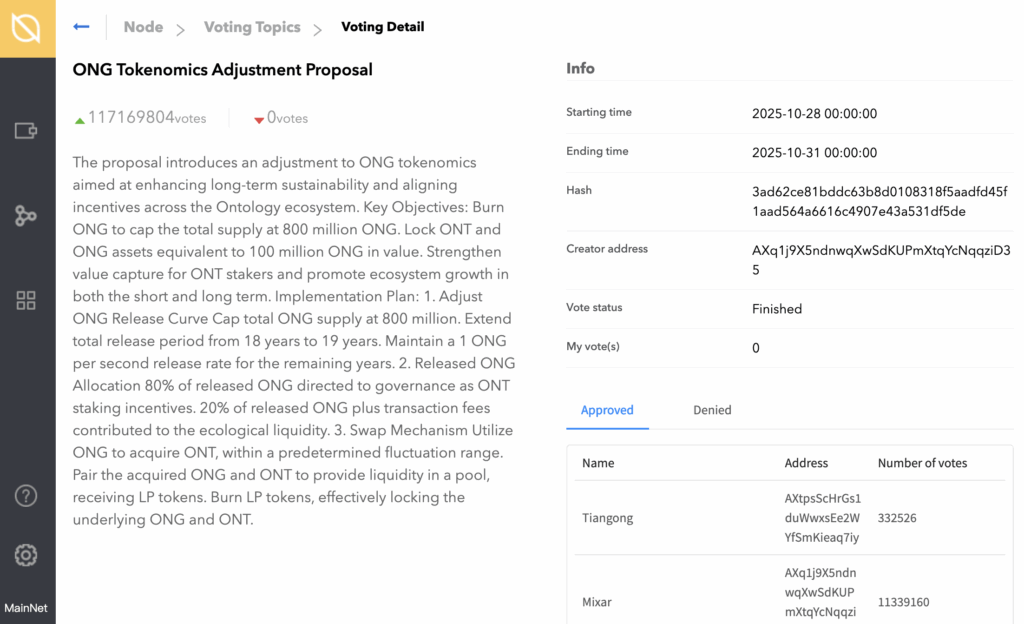
After three days of on-chain voting between October 28 and October 31, 2025 (UTC), Triones nodes approved the ONG Tokenomics Adjustment Proposal with 117 million votes in favor and zero votes against.
This is one of the strongest expressions of community alignment in Ontology’s history.
With the mainnet upgrade complete, this announcement marks more than a technical update.
It reflects a cultural shift toward long-term sustainability, stronger liquidity, and a builder-first mindset.
Why This Matters for the Ontology Community
Ontology’s two-token system is designed for reliability and security:
- ONT powers governance and staking
- ONG fuels transactions, network usage, and contributor rewards
By permanently reducing ONG’s supply, this upgrade strengthens the long-term foundation of the ecosystem.
This vote was not just about token mechanics.
It was about the culture we want to build:
- A culture of clarity
- A culture of sustainability
- A culture where builders can trust the system to support their work for decades
The Key Changes, Clearly Explained
ONG Max and Total Supply Reduced to 800 Million
- 200 million ONG has been permanently burned
- Maximum and total supply is now fixed at 800 million ONG
This is a hard cap. No additional ONG can ever be created beyond this limit.
A tighter supply model creates a stronger foundation for long-term value, predictability, and confidence.
Circulating Supply Is Unchanged Today, but Will Reduce Over Time
There is no immediate change to circulating supply.
However:
- 100 million ONG worth of ONT and ONG is now being permanently locked through the new liquidity mechanism
- These assets are removed from circulation forever
Over time, this is expected to reduce effective circulating supply to approximately 750 million ONG, assuming 1 ONG ≈ 1 ONT.
This aligns with Ontology’s commitment to responsible token management and long-term supply discipline.
ONG Emissions Remain Stable and Predictable
ONG has always followed a steady, transparent release schedule.
To avoid a sharp increase in emissions near the end of the original schedule, the community approved a small extension.
Key points:
- ONG continues to release at 1 ONG per second
- The release period extends from 18 years to approximately 19 years
- The emission curve remains smooth and predictable
This ensures long-term stability for stakers, developers, and ecosystem partners.
The Core of This Upgrade: Stronger, Permanent Liquidity
Liquidity is not a technical footnote.
It is foundational to a healthy ecosystem.
A strong network is one where:
- Users can move assets with confidence
- Builders trust liquidity depth for real usage
- Developers avoid sudden market shocks
- Long-term contributors are protected from instability
How the New Liquidity Mechanism Works
- ONG is used to acquire ONT
- ONG and ONT are paired into liquidity provider (LP) tokens
- LP tokens are permanently burned
- The underlying assets are locked forever
This creates permanent, non-removable liquidity that strengthens Ontology’s DeFi and infrastructure layers.
The result is a more resilient market environment that builders can rely on.
Community Questions Answered
How long will the ONT and ONG equivalent to 100 million ONG remain locked?
Permanently.
Why was the release period extended?
To maintain a stable emission rate rather than increasing emissions sharply near the end of the original schedule.
Will ONT staking rewards change?
ONG emissions decrease slightly (around 20%).
However, tighter supply and stronger liquidity may improve long-term value for stakers.
How does this benefit the ecosystem?
With:
- A hard cap of 800 million ONG
- An immediate burn of 200 million ONG
- 100 million ONG permanently locked via burned liquidity
The token economy becomes healthier, more predictable, and more sustainable.
Who participated in the vote?
All Triones nodes voted via OWallet.
What Happens Next
The mainnet upgrade is complete, and all tokenomics improvements are now active.
Ongoing monitoring will focus on:
- Staking incentives
- DEX liquidity health
- ONG emission progress
- Long-term supply management
The rollout is designed to remain smooth and stable for all participants.
Building a Culture Builders Can Trust
This upgrade is not just about numbers.
It represents Ontology’s values:
- Predictability
- Sustainability
- Transparency
- Liquidity deep enough to support real activity
- A long-term mindset that respects both users and builders
Thank you to every community member and node that participated.
This decision sets the tone for Ontology’s next chapter.
We’re building for the long term — and we’re building it together.
]]>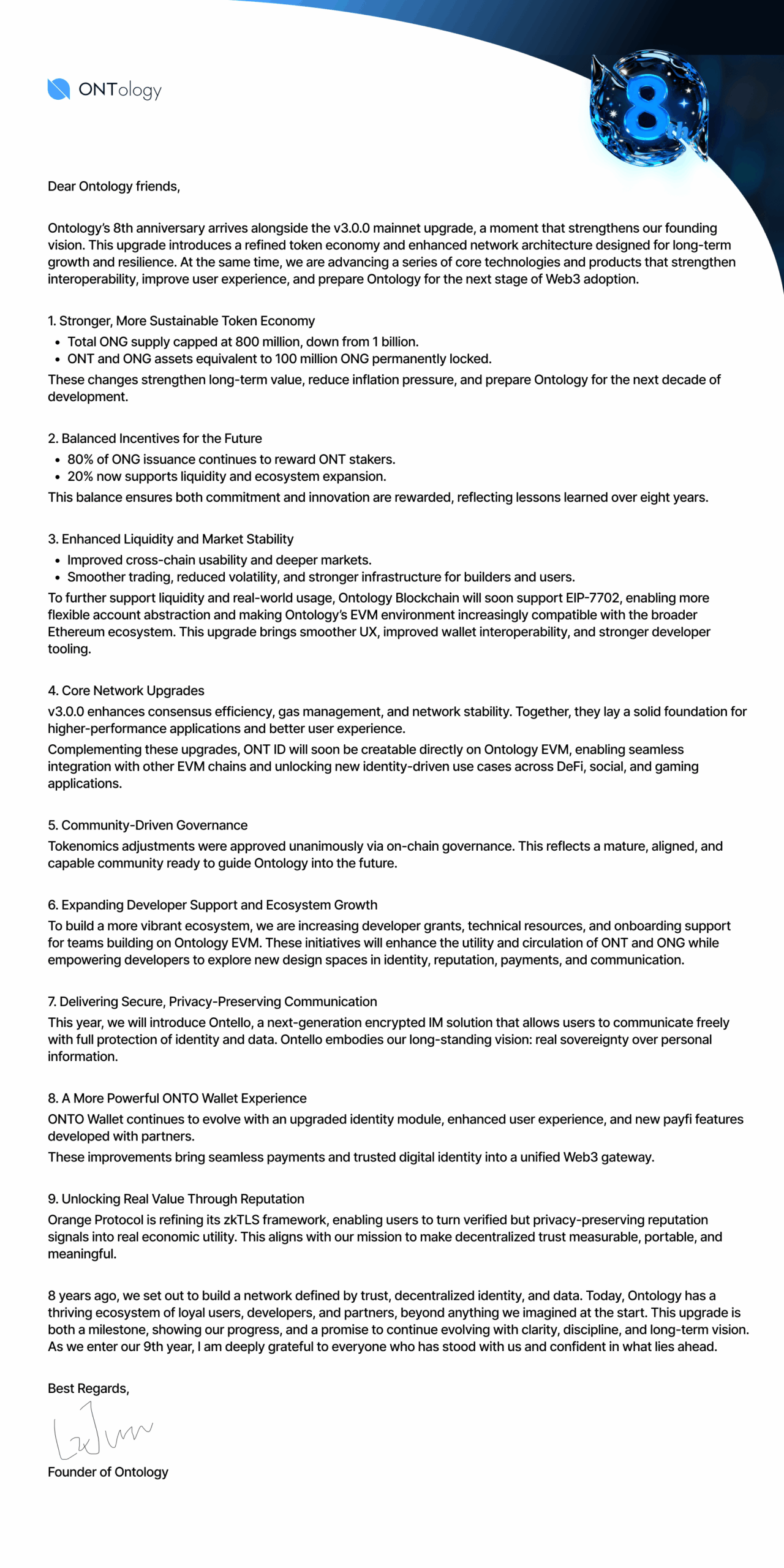
Key Highlights From Ontology’s v3.0.0 MainNet Upgrade
Strengthened Token Economy and Incentive Model
Ontology’s v3.0.0 upgrade introduces major improvements to Ontology’s dual-token model (ONT and ONG), designed to support long-term sustainability and ecosystem growth.
- The total ONG supply has been reduced from 1 billion to 800 million, with 100 million ONG permanently locked. This lowers inflation and strengthens long-term token value.
- Updated reward distribution now allocates 80% of newly issued ONG to ONT stakers and 20% to liquidity and ecosystem expansion, balancing network security with growth incentives.
These changes align Ontology’s token model with long-term utility and healthier economic design.
Network Upgrades, Identity Integration, and Governance
The v3.0.0 upgrade enhances the core performance, interoperability, and identity tooling of the Ontology Blockchain.
- Upcoming support for EIP-7702 will introduce a more flexible account system and stronger compatibility with the Ethereum ecosystem, improving cross-chain liquidity and builder experience.
- Core upgrades to consensus, stability, and gas management make the network faster and more reliable.
- ONT ID will soon be creatable directly on Ontology EVM, unlocking seamless decentralized identity use cases across DeFi, gaming, and social platforms.
- All tokenomics updates were approved through on-chain governance, reflecting a mature and aligned Ontology community.
These improvements position Ontology as a more interoperable, identity-driven, and community-governed Web3 infrastructure layer.
Product Enhancements, Developer Growth, and Real-World Utility
Ontology continues to expand its ecosystem with new tools, user experiences, and privacy-preserving features.
- Expanded grants, developer tools, and onboarding resources make it easier to build with ONT, ONG, and ONT ID.
- A new encrypted IM solution launching later this year will leverage decentralized identity and zero-knowledge technology to protect user sovereignty and secure communication.
- The ONTO Wallet has been upgraded with a refined identity module, better UX, and new payfi functionality developed with partners, improving Web3 payments and digital identity management.
- Orange Protocol is advancing its zkTLS framework to turn verified, privacy-preserving reputation signals into real economic utility — strengthening Ontology’s mission to make decentralized trust measurable and portable.
Recommended Reading
ONG Tokenomics Adjustment Proposal Passes Governance vote
The proposal secured over 117 million votes in approval, signaling strong consensus within the network to move forward with the next phase of ONG’s evolution.
Initial update about the upcoming MainNet v3.0.0 upgrade and Consensus Nodes upgrade on December 1, 2025. This release will improve network performance and implement the approved ONG tokenomics update.
8 Years of Trust – Your Story Campaign
The first campaign to kick off Ontology’s 8th anniversary celebrations. It shares updates from the 2025 roadmap along with details on how to win rewards just for sharing your story with Ontology. We want to hear from you!
Your Guide to Joining The Node Campaign
Everything you need to know about how to get involved in Ontology’s node campaign, including key dates and requirements.
After three days of voting, from October 28 to October 31, 2025 (UTC), Ontology Triones Nodes reached a unanimous decision in favor of the proposal. The proposal secured over 117 million votes in approval, signaling strong consensus within the network to move forward with the next phase of ONG’s evolution.
A Vote for Long-Term Sustainability
This proposal represents a significant step in refining ONG’s tokenomics to ensure long-term stability, strengthen staking incentives, and promote sustainable ecosystem growth.
Here’s a quick recap of what’s changing and why it matters.
Key Objectives
- Cap total ONG supply at 800 million.
- Lock ONT and ONG equivalent to 100 million ONG in value to strengthen liquidity and reduce circulating supply.
- Rebalance incentives for ONT stakers while ensuring long-term token sustainability.
- ONG Max and Total Supply will decrease from 1 billion to 800 million, with 200 million ONG burned immediately.
- ONG Circulating Supply remains unchanged immediately after the event; however, circulating supply could drop to around 750 million (assuming that 1 $ONG = 1 $ONT) in the future due to the permanent lock mechanism.
Implementation Plan
- Adjust ONG Release Curve
- Cap total supply at 800 million ONG.
- Extend total release period from 18 to 19 years.
- Maintain a consistent 1 ONG per second release rate for the remaining years.
- Released ONG Allocation
- 80% of released ONG will continue to flow to governance as ONT staking incentives.
- 20%, plus transaction fees, will be contributed to ecological liquidity.
- Swap Mechanism
- ONG will be used to acquire ONT within a set fluctuation range.
- The acquired ONG and ONT will be paired to provide liquidity and generate LP tokens.
- LP tokens will be burned, permanently locking the underlying assets to maintain supply discipline.
Community Q&A Highlights
Q1. How long will the ONT + ONG (worth 100 million ONG) be locked?
It’s a permanent lock.
Q2. Why extend the release period if total ONG supply decreases?
Under the previous model, the release rate increased sharply in the final years. By keeping the release rate steady at 1 ONG per second, the new plan slightly extends the schedule — from 18 to roughly 19 years — while maintaining predictable emissions.
Q3. Will ONT staking APY be affected?
Rewards will shift slightly, with ONG emissions reduced by around 20%. However, as ONG becomes scarcer, its market value could rise, potentially offsetting or even improving overall APY.
Q4. What does this mean for the Ontology ecosystem?
With the total supply capped and 200 million ONG burned immediately, and 100 million $ONG equivalent-valued $ONG and $ONT permanently locked, effective circulating supply could drop to around 750 million (assuming that 1 $ONG = 1 $ONT). This scarcity, paired with ongoing ONG utility and swapping mechanisms, should strengthen market dynamics and improve long-term network health.
Q5. Who was eligible to vote?
All Triones nodes participated via OWallet, contributing to Ontology’s decentralized governance process.
The Vote at a Glance
| Proposal | ONG Tokenomics Adjustment |
|---|---|
| Voting Period | Oct 28–31, 2025 (UTC) |
| Vote Status |  Approved Approved |
| Total Votes in Favor | 117,169,804 |
| Votes Against | 0 |
| Status | Finished |
What Happens Next
With the proposal approved, the Ontology team will begin implementing the updated tokenomics plan according to the outlined schedule. The gradual rollout will ensure stability across the staking ecosystem and DEX liquidity pools as the new mechanisms are introduced.
This marks an important milestone in Ontology’s ongoing effort to evolve its token economy and strengthen decentralized governance.
As always, we thank our Triones nodes for participating and shaping the direction of the Ontology network.
Stay tuned for implementation updates and the next phase of Ontology’s roadmap.
]]>