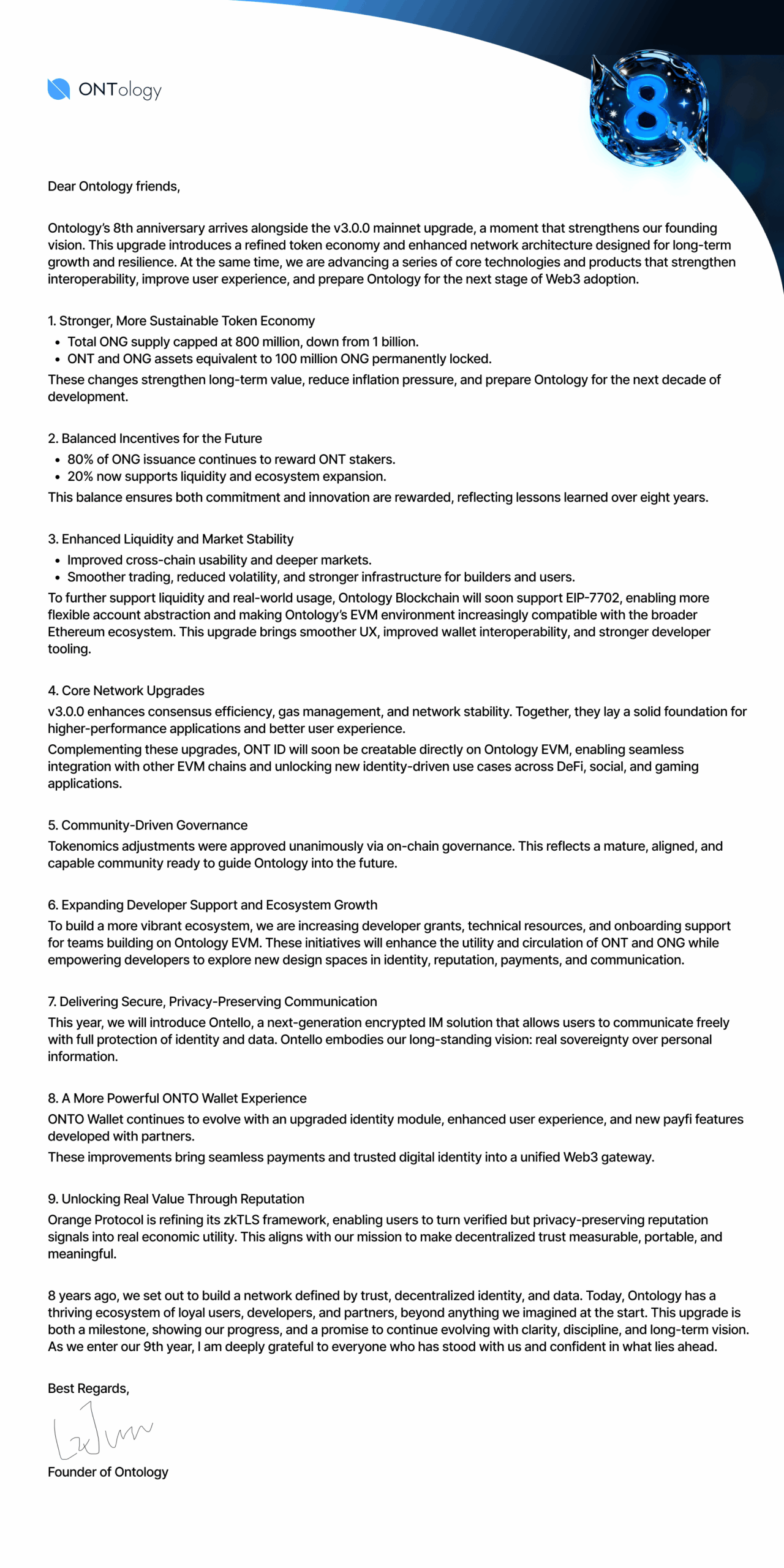
Key Highlights From Ontology’s v3.0.0 MainNet Upgrade
Strengthened Token Economy and Incentive Model
Ontology’s v3.0.0 upgrade introduces major improvements to Ontology’s dual-token model (ONT and ONG), designed to support long-term sustainability and ecosystem growth.
- The total ONG supply has been reduced from 1 billion to 800 million, with 100 million ONG permanently locked. This lowers inflation and strengthens long-term token value.
- Updated reward distribution now allocates 80% of newly issued ONG to ONT stakers and 20% to liquidity and ecosystem expansion, balancing network security with growth incentives.
These changes align Ontology’s token model with long-term utility and healthier economic design.
Network Upgrades, Identity Integration, and Governance
The v3.0.0 upgrade enhances the core performance, interoperability, and identity tooling of the Ontology Blockchain.
- Upcoming support for EIP-7702 will introduce a more flexible account system and stronger compatibility with the Ethereum ecosystem, improving cross-chain liquidity and builder experience.
- Core upgrades to consensus, stability, and gas management make the network faster and more reliable.
- ONT ID will soon be creatable directly on Ontology EVM, unlocking seamless decentralized identity use cases across DeFi, gaming, and social platforms.
- All tokenomics updates were approved through on-chain governance, reflecting a mature and aligned Ontology community.
These improvements position Ontology as a more interoperable, identity-driven, and community-governed Web3 infrastructure layer.
Product Enhancements, Developer Growth, and Real-World Utility
Ontology continues to expand its ecosystem with new tools, user experiences, and privacy-preserving features.
- Expanded grants, developer tools, and onboarding resources make it easier to build with ONT, ONG, and ONT ID.
- A new encrypted IM solution launching later this year will leverage decentralized identity and zero-knowledge technology to protect user sovereignty and secure communication.
- The ONTO Wallet has been upgraded with a refined identity module, better UX, and new payfi functionality developed with partners, improving Web3 payments and digital identity management.
- Orange Protocol is advancing its zkTLS framework to turn verified, privacy-preserving reputation signals into real economic utility — strengthening Ontology’s mission to make decentralized trust measurable and portable.
Recommended Reading
ONG Tokenomics Adjustment Proposal Passes Governance vote
The proposal secured over 117 million votes in approval, signaling strong consensus within the network to move forward with the next phase of ONG’s evolution.
Initial update about the upcoming MainNet v3.0.0 upgrade and Consensus Nodes upgrade on December 1, 2025. This release will improve network performance and implement the approved ONG tokenomics update.
8 Years of Trust – Your Story Campaign
The first campaign to kick off Ontology’s 8th anniversary celebrations. It shares updates from the 2025 roadmap along with details on how to win rewards just for sharing your story with Ontology. We want to hear from you!
Your Guide to Joining The Node Campaign
Everything you need to know about how to get involved in Ontology’s node campaign, including key dates and requirements.
Identity, privacy, and AI are colliding fast. In this community conversation, builders and advocates examined who should own identity online, how to protect privacy, and how AI agents change the trust model for everything we do on the internet.
Featured speakers
- Humpty — long-time contributor and advocate of decentralized identity and privacy
- Geoff — veteran ecosystem builder and Head of Community at Ontology
- Barnabas — grassroots organizer driving Web3 education and adoption across Africa
Five core takeaways
Ownership and agency come first
Web3 should let people own their identity and control what they share. Identity is not a wallet address. It is a richer record that reflects consent and context.
“You are in control of your data, and you get to choose what you want people to see.” — Barnabas
Privacy with portability
Identity must work across apps and chains while preserving privacy. Single-chain IDs limit users.
“Portable identity should not work only on one chain.” — Humpty
Design for everyone
Education and simple UX are essential so new users can participate without feeling overwhelmed.
“Removing barriers is essential to building community.” — Geoff
AI needs attribution and reputation
As AI agents multiply, we must evaluate outputs and the credibility of agents and their builders.
“We need attribution to know if a result is good, outdated, or hallucinated.” — Humpty
A builder’s opening
There is real opportunity to launch AI apps and agents with verifiable identity and reputation that users can trust.
“Start thinking about how you can develop those AI apps to launch in the marketplace.” — Geoff
Bigger picture
Identity is becoming shared infrastructure. It underpins privacy, enables reputation, and helps us decide which people or agents to trust. As AI agents begin to outnumber humans online, transparent identity and reputation will guide safe participation for everyone.
TL;DR
User-owned identity must be private and portable. Education and simple UX bring people in. AI raises the stakes for attribution and reputation, which is a clear opportunity for builders to ship trustworthy agents tied to real user intent.
Related reading
]]>According to the FTC, Americans reported losing $10 billion to fraud in 2023, with identity theft leading the pack. It’s the modern version of pickpocketing, except instead of stealing your wallet, someone’s stealing your entire digital existence.
What Identity Theft Really Is
At its core, identity theft is someone pretending to be you. In the Web2 world, that usually means taking enough of your personal information to open a loan, drain your bank account, or file taxes in your name. The playbook hasn’t changed much in two decades — but the surface area has exploded.
- Phishing emails dressed up as your bank.
- SIM swaps where a scammer convinces your phone carrier to hand over your number.
- Centralized database hacks that leak millions of identities in one go. (Think Equifax, but it happens almost weekly now.)
The problem is simple: the internet was never built to prove who you are. We’ve been duct-taping passwords, cookies, and secret questions on top of a system that wasn’t designed for trust.
Why It’s Getting Worse
The more services that ask you to hand over your identity, the more places it can be stolen. Every time you sign up for something with your email, birth date, and phone number, that data gets stored in some corporate silo. Hack one of those silos, and the attacker isn’t just inside your account — they’re inside millions of accounts.
And while regulators keep telling companies to do better, the truth is simple: centralized identity systems are always going to be a honeypot for hackers.
The Web3 Shift
This is where things start to get interesting. Web3 isn’t just about trading coins on decentralized exchanges. It’s about rethinking ownership — not just of money, but of identity.
- Decentralized Identity (DID): Instead of hundreds of logins scattered across the web, you carry your identity with you, cryptographically secured, and decide who gets to see what.
- Self-Sovereign Identity (SSI): You’re not “logging in with Google” anymore. You are the login.
- Zero Knowledge Proofs (ZKPs): Imagine proving you’re over 18 without handing over your birthday. That’s not science fiction — that’s ZKPs in action.
In this model, your personal data doesn’t live on some company’s server, waiting to be stolen. It lives with you. And when someone asks for proof — whether it’s your age, your credit score, or your right to vote — you can share only what’s needed, nothing more.
How to Protect Yourself Right Now
Web3 might be the future, but identity theft is still very much a present problem. A few simple steps can dramatically cut your risk:
- Use a password manager and make sure every login is unique.
- Turn on two-factor authentication everywhere (preferably with an authenticator app, not SMS).
- For crypto wallets, stick to hardware wallets and never share private keys.
- Be skeptical of anyone — anyone — who asks you to “verify” sensitive information over email or text.
- Start experimenting with DIDs and self custody solutions. Even dipping your toes in now puts you ahead of the curve.
The Bigger Picture
Identity theft isn’t going away. As long as our data lives in centralized silos, hackers will keep breaking in. What Web3 offers is a chance to redesign the entire system: to make identity something you actually own, instead of something dozens of corporations guard on your behalf.
The promise here isn’t just fewer phishing scams. It’s a future where your identity can’t be stolen in the first place — because it’s finally, truly yours.
]]>